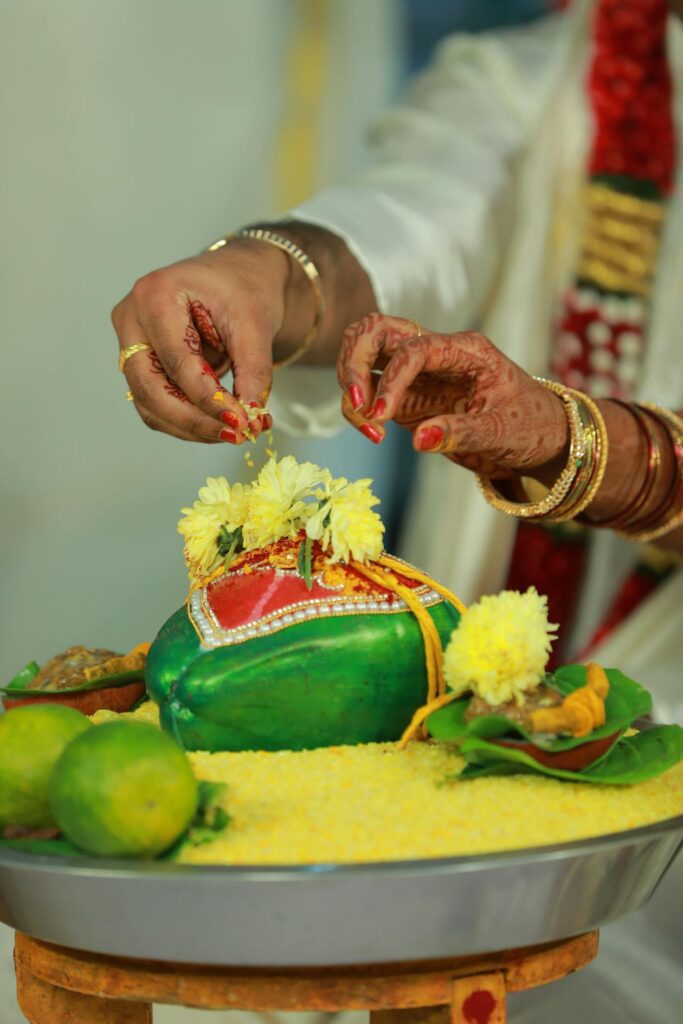
Indian weddings averaged 327 guests in 2024-2025 across UK and Gulf markets — the largest single-event guest counts in the wedding industry, with diaspora celebrations in London, Dubai, Toronto and New Jersey routinely crossing 500 attendees. At MOQ 100 with a 4-SKU split (25 units per ceremony), couples can offer a different scent for each day of the celebration starting at $2.40-$5.50 per unit DDP. This guide walks through how the traditional attar palette — jasmine, rose, sandalwood and cardamom — translates into modern French-manufactured favors that meet IFRA Amendment 51 compliance, ship door-to-door across continents, and respect the cultural weight of gift-giving in South Asian wedding traditions.
Plan your multi-ceremony favor program on WhatsApp: +33 6 17 74 77 13
The Cultural Roots of Attar in South Asian Wedding Traditions
Attar — sometimes spelled ittar or itr — refers to a family of traditional perfume oils distilled in copper deg-and-bhapka stills, a method documented in South Asia for several centuries. Three notes anchor the wedding canon. Rose attar (gulab) carries associations with Mughal-era court perfumery and remains the single most common scent in pre-wedding rituals. Jasmine (motia or chameli) appears in garlands worn by both bride and groom, and the scent is woven into the visual and olfactory memory of the ceremony itself. Sandalwood (chandan) anchors the base of countless attars and shows up in the haldi paste applied to the couple before the wedding day.
Cardamom (elaichi) is less often described as a standalone perfume note, but it appears throughout the sensory landscape — in welcome drinks, sweets, and the kahwa served at receptions. As a fragrance ingredient, green cardamom adds a bright, slightly resinous lift that pairs naturally with rose and sandalwood.
For couples planning a 2026 wedding, this matters because perfume favors that nod to these notes feel grounded rather than generic. Guests recognize the reference. Older relatives recognize it more strongly than younger ones, which is part of the design point.
The Modern Hybrid: French Manufacturing Meets Traditional Notes
Traditional attar production has two practical issues for a wedding favor program. First, authentic deg-distilled attars vary batch to batch and can be hard to source in volumes of 300-800 identical units. Second, several historical attar bases — particularly some animalic and resinous notes — do not meet current IFRA Amendment 51 limits when used at high concentration in skin-applied products. A couple ordering 600 favors needs consistency, regulatory compliance, and the ability to ship the product internationally without customs holds.
The hybrid approach is straightforward. A French perfumer interprets the traditional palette using modern raw materials sourced for IFRA compliance — Bulgarian rose absolute, Indian jasmine sambac, Australian sandalwood (Santalum spicatum), and steam-distilled green cardamom from Guatemala or Kerala. The fragrance is built to ISO 22716 cosmetic GMP standards, manufactured in a Grasse-region facility, and certified Made in France. The olfactory result reads as recognizably attar-adjacent. The regulatory paperwork reads as fully compliant for export to India, the UAE, the UK, the US, Canada, and the EU.
This is not a replacement for ceremonial attar — couples often still use authentic gulab or chameli oil in the rituals themselves. The favor is a parallel object: a small bottle that guests take home, use, and remember.
The Multi-Event Favor Strategy: One Scent Per Ceremony
A typical Indian wedding spans three to seven days. The most common structure is Mehendi, Sangeet, Haldi, the Wedding ceremony itself, and a Reception. Some families add a Tilak, a Roka, or a separate Vidaai brunch. Each event has its own dress code, its own music, and frequently its own venue. A single favor scent across all of them is workable, but a four-SKU split fits the structure better.
The math works at MOQ 100. The factory minimum is 100 total units across one fragrance. Within that 100, the SKU minimum is 25 units per scent variant (driven by the bottling and labeling line setup). A couple ordering 400 favors can therefore split the order into four 100-unit fragrance pours, or into a single 100-unit pour repeated four times with different labels, or into a 4-SKU mixed program at 100 units per SKU. The most common configuration we see is 4 SKUs at 100 units each — total 400 favors, one fragrance assigned to each major ceremony.
Smaller events (300 favors) work as 3 SKUs at 100. Larger events (800 favors) work as 4 SKUs at 200 or 5 SKUs at 160. The constant is the 25-unit-per-SKU floor.
Mandatory Pricing Tiers
The table below reflects DDP pricing — duties, taxes and door-to-door shipping included — for the four most common Indian wedding favor configurations. All prices assume Made-in-France manufacturing, IFRA Amendment 51 compliant fragrance, and custom labels printed at zero setup fee.
| Configuration | Total units | Format | SKUs | Per-unit DDP (India) | Per-unit DDP (UK/UAE) | Per-unit DDP (US) |
| Entry — single scent | 100 | 10 ml roll-on | 1 | $5.50 | $4.90 | $5.20 |
| Mid — single scent | 300 | 15 ml spray | 1 | $4.20 | $3.80 | $4.05 |
| Mid — 4 ceremonies | 400 | 10 ml roll-on | 4 | $3.40 | $3.10 | $3.25 |
| Volume — full program | 600 | 15 ml spray | 4 | $2.90 | $2.60 | $2.75 |
| Large diaspora event | 800+ | 10-30 ml mix | 4-5 | $2.40 | $2.20 | $2.30 |
Lead time is 14 production days from artwork sign-off, plus 4-7 days DDP transit to India, 3-5 days to the UK, 2-4 days to the UAE, and 5-8 days to the US East Coast. The 50/50 payment structure (50% on order, 50% before dispatch) applies to all configurations.
Ceremony × Scent Assignment Matrix
The matrix below is a working starting point — couples adapt it to family preferences, but the logic of pairing lighter scents with daytime ceremonies and richer ones with the wedding day holds across most programs.
| Ceremony | Time of day | Mood | Recommended scent | Core notes |
| Mehendi | Afternoon, outdoor | Bright, festive | Cardamom & Rose Lift | Green cardamom top, rose heart, light sandalwood base |
| Sangeet | Evening, indoor | Warm, dance-floor | Jasmine & Sandalwood Veil | Jasmine sambac, sandalwood, soft saffron accent |
| Haldi | Morning, intimate | Earthy, ceremonial | Sandalwood & Turmeric Memory | Sandalwood-forward, dry woods, faint warm spice |
| Wedding ceremony | All-day | Full spice signature | Rose Attar & Cardamom Crown | Rose absolute, cardamom, jasmine, sandalwood — the full palette |
| Reception | Evening, modern venue | Fresh, contemporary | Jasmine & Champaca Modern | Jasmine, champaca floral, clean musk close |
A simpler 4-SKU program drops Haldi and runs Mehendi-Sangeet-Wedding-Reception. A 3-SKU program merges Mehendi and Sangeet into a single “pre-wedding” scent.
Get a sample set of all four ceremony scents on WhatsApp: +33 6 17 74 77 13
DDP Shipping to India, UAE, UK, and the US
Indian-diaspora weddings split the logistics question into two parts. Where is the wedding held, and where do the favors need to ship to? A wedding in Udaipur with guests flying in from London means favors land in India. A wedding in London with guests from Mumbai means favors land in the UK. A Dubai destination wedding means favors land in the UAE. We see all three regularly.
DDP — Delivered Duty Paid — means the price quoted includes the freight, the customs clearance, the import duty, and the local last-mile delivery to the venue or the planner’s office. For India specifically, this matters because cosmetic imports require a CDSCO registration check at customs, and the consignment needs the IFRA certificate, the ingredient declaration in English, and the manufacturing GMP statement. We file these documents on every shipment as standard. Couples and planners do not handle paperwork.
Transit times: India 4-7 working days from Paris dispatch (Mumbai, Delhi, Bangalore, Hyderabad, Chennai hubs). UAE 2-4 days (Dubai, Abu Dhabi). UK 3-5 days (London, Manchester, Birmingham). US 5-8 days East Coast, 6-10 days West Coast. Canada 6-9 days (Toronto, Vancouver). For weddings in tier-2 Indian cities — Jaipur, Lucknow, Indore, Coimbatore — add 1-2 days for domestic relay.
Multilingual Custom Labels: Hindi, Punjabi, Gujarati Alongside English
Label artwork is often where the cultural identity of the favor lives. The standard configuration we ship is bilingual: English on one face of the label, the family’s preferred Indic script on the other. Most common is Devanagari (used for Hindi and Marathi). Gurmukhi for Punjabi families. Gujarati script for Gujarati families. Tamil, Telugu, Bengali, and Urdu (Nastaliq) are all available — we work from typed text the couple supplies and our pre-press team handles the kerning and script-rendering checks.
Common label content includes the couple’s names, the wedding date in both Gregorian and Vikram Samvat or Saka calendar formats if requested, a short blessing or shloka, and the ceremony name (Mehendi, Sangeet, etc.) for ceremony-specific SKUs. Custom label setup is zero fee — couples pay only for the label printing itself, which is included in the per-unit price.
A practical note on artwork: send us the Indic-script text as typed Unicode rather than as an image when possible. It allows our designers to adjust sizing without pixelation, and it lets us run a proofing pass with a native reader before going to press.
Packaging Respect: Gift-Giving Etiquette
Indian wedding favors are not afterthoughts. The shagun and the return-gift tradition gives the object real social weight, and packaging is read accordingly. Three considerations come up regularly.
First, color. Red, gold, and deep magenta are widely auspicious. White-only packaging without colored accents reads as muted in a wedding context — it works for some modern receptions but is unusual for the wedding ceremony itself. We offer pouches and outer boxes in red, gold, ivory-with-gold, and contemporary options like dusty rose or bottle green.
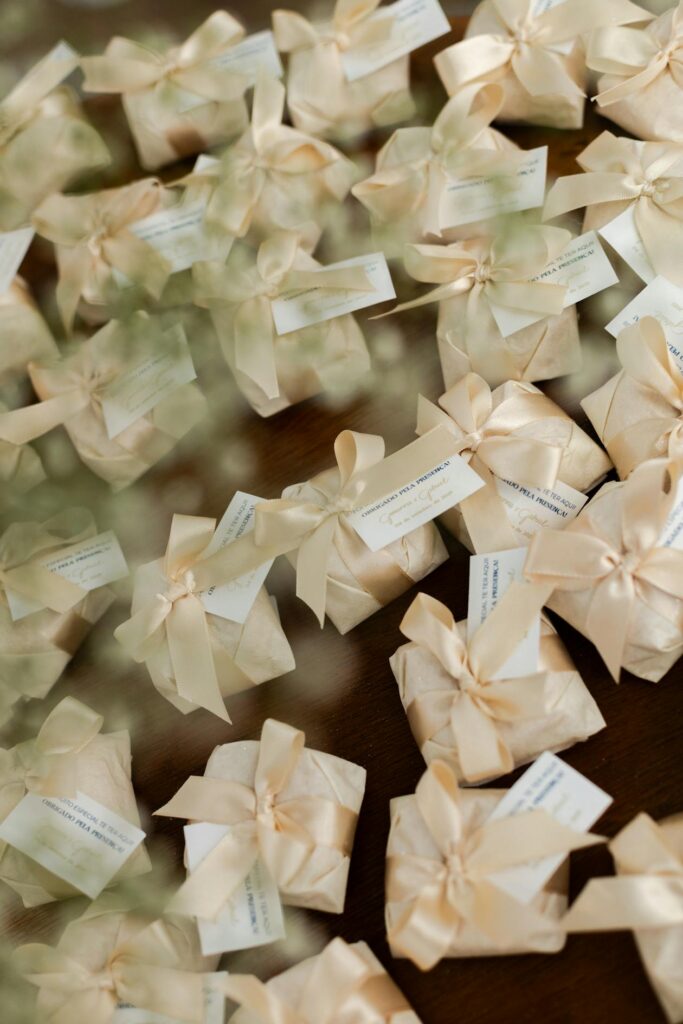
Second, single-use plastics and the unwrapping moment. Many couples ask for a small organza pouch with a drawstring rather than a sealed shrink-wrap, because guests like to open the favor at the table. Pouches add roughly $0.40-$0.80 per unit and come in coordinating colors.
Third, the box-set option for VIP guests. A common pattern is to ship 90% of the order as individual favors and 10% as 4-bottle ceremony sets in a printed box, used for immediate family, the priest, and senior guests. The set version runs $14-$22 per box DDP depending on volume.
Guest Count Realities: 300-800+
A note on planning. Couples sometimes underestimate final attendance for diaspora events because the RSVP culture differs from Western weddings. We recommend ordering 5-10% over the confirmed RSVP count for safety, and ordering ceremony-specific SKUs proportional to expected attendance per event — Mehendi often pulls 60-70% of total guests, Sangeet pulls 80-90%, the wedding ceremony pulls 95-100%, and the reception often peaks at 100-110% (because of additional guests invited for the reception only).
For a 600-guest wedding, a typical SKU split is: Mehendi 150, Sangeet 200, Wedding 250, Reception 300. Total 900 favors across 4 SKUs. Per-unit DDP at this volume sits at the bottom of the pricing table.
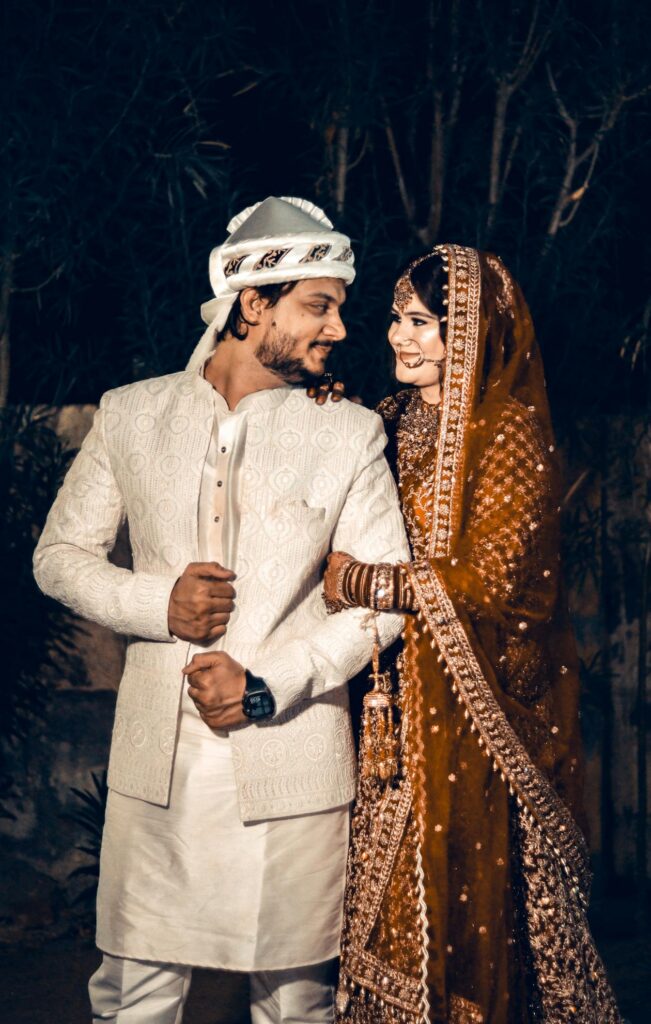
Why Wedding Perfume Favors Fits Indian Weddings
The 4-SKU split at MOQ 100 is the structural fit. Most factories require 500-1,000 units per fragrance variant, which forces couples into single-scent programs even when they want ceremony differentiation. Our 25-unit-per-SKU floor inside a 100-unit total order makes ceremony-specific scents accessible at any guest-count tier from 100 upward.
Multilingual label support is built into the production line, not a one-off accommodation. Hindi, Gujarati, Punjabi, Tamil, Telugu, Bengali and Urdu artwork pass through the same proofing workflow as English and French. IFRA Amendment 51 compliance is verified per batch, with paperwork supplied for India CDSCO, UAE ESMA, UK CTPA and US FDA cosmetic notification as required. 1,000+ historical references in the catalogue mean the perfumer can pull a starting profile close to the brief on day one rather than building from zero.
Common Mistakes Couples Make on Indian Wedding Perfume Favors in 2026
Ordering authentic concentrated attar oil for 500 guests. True deg-distilled attar at 100% concentration is beautiful but rarely IFRA-compliant for international shipping at scale, and consistency across a 500-unit batch is difficult. Use a French-manufactured interpretation for the favor and reserve authentic attar for the ritual itself.
Single scent across all four ceremonies. Guests attending multiple events end up with four identical bottles. The 4-SKU split costs the same per unit at MOQ 100 and gives each ceremony a distinct keepsake.
English-only labels. A wedding that codes strongly as Indian throughout the decor and music can feel jarring with English-only favor labels. Bilingual labels are zero setup fee — there is no reason to skip the Indic script.
Ordering exact RSVP count. Indian weddings frequently see day-of additions, particularly at the reception. Order 5-10% over confirmed count.
Forgetting the reception scent should differ. The reception is often the most modern event of the program — held at a hotel, with Western dress alongside lehengas. A lighter, fresher scent (jasmine and champaca) reads better in this setting than the full attar palette used on the wedding day.
What This Means for Your Wedding
Action one. Map your ceremonies on a single sheet — Mehendi, Sangeet, Haldi, Wedding, Reception, with expected attendance for each. Decide which ceremonies get a unique scent and which share one.
Action two. Decide on label languages. Confirm the Indic script (Devanagari, Gurmukhi, Gujarati, etc.), the calendar format, and any blessing text you want printed. Send typed Unicode text, not screenshots.
Action three. Lock the delivery address and the date — wedding venue in India, planner’s office in London, family home in New Jersey. DDP shipping is calculated against the destination, and a 14-day production window plus transit means orders should be placed roughly 5-6 weeks before the first ceremony.
Start your 4-SKU ceremony program on WhatsApp: +33 6 17 74 77 13 — or request a written quote.
Continue Your Research
- Pillar overview: /wedding-perfume-favors/
- Neighbors: /luxury-wedding-perfume-favors/ | /destination-wedding-perfume-favors/ | /themed-wedding-perfume-favors/
- Customization: /wedding-perfume-favor-labels/
- Volume planning: /bulk-wedding-perfume-favors/