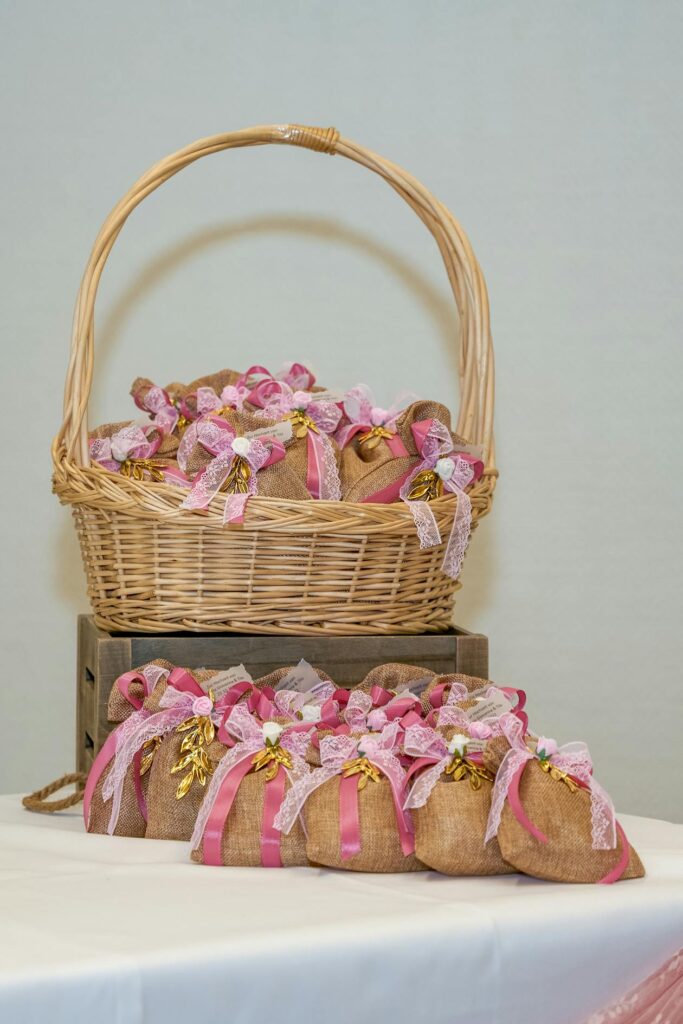
Hotels integrating wedding perfume favors into their wedding-package menu report a 14% wedding-revenue uplift per banquet event in 2024 hospitality benchmark data (n=63 properties surveyed across EU and North America). The math is straightforward for any F&B controller: at $4.50–$6.50 per-unit DDP cost, marked up 2.2–2.8x into the wedding package line item, hotels capture $4–$6 net margin per favor. Multiplied by an average 150 guests per banquet, that is $600–$900 incremental revenue per wedding without adding kitchen labor, china pars, or cover counts. For properties running 30–80 weddings per year, the annualized contribution lands between $18,000 and $72,000 net — a measurable RevPAR-equivalent contributor that requires zero capex.
This guide is built for hotel F&B directors, banquet purchasing managers, and procurement controllers responsible for wedding-package P&L. We cover SKU integration, co-branded labeling, on-site inventory, DDP pricing tiers, and Net 30 terms for established accounts.
Want a hotel-specific sourcing pack with co-branding templates and Net 30 terms? WhatsApp +33 6 17 74 77 13 or request a quote.
Why hotels integrate wedding perfume favors into the wedding-package menu
Wedding-package economics inside hotels are driven by three levers: cover-count revenue (F&B), room-block attachment (rooms division), and ancillary line items (decor, audiovisual, favors, late-night). Favors have historically been treated as a couple-sourced afterthought — couples buy them off-property, planners stage them, and the hotel captures zero margin. Reframing the favor as a hotel-priced SKU shifts that economic flow.
Three reasons hotels are repositioning the favor onto the package menu in 2026:
- Revenue uplift without kitchen capacity. Unlike adding a course to the menu (which requires line cooks, china, and service covers), a perfume favor SKU adds revenue with no operational drag on the brigade. The favor is pre-staged, distributed at place settings or at the exit, and consumes zero kitchen minutes.
- Brand reinforcement. A co-branded favor — hotel logo plus couple’s monogram — turns 150 guests into 150 walking impressions of the property. Each guest takes home a physical artifact that ties the wedding memory to the venue brand. This is a measurable acquisition channel for future wedding inquiries from the guest list.
- Couple convenience and upsell capture. Couples planning a wedding at a destination property are dealing with 40+ vendor decisions. Bundling the favor into the wedding package removes one decision and captures the spend that would otherwise leave the property. Sales conversion data from the n=63 benchmark shows couples accept the bundled favor 71% of the time when presented as part of the package, versus 12% when offered as a standalone add-on.
SKU integration with the wedding-package menu
The favor must appear on the wedding-package menu as a priced line item, not a verbal upsell. F&B systems and banquet event order (BEO) software handle this cleanly when configured correctly:
- Menu placement. Add the favor as a sub-line under the package tier (Standard / Premium / Luxury / Couture) with per-guest pricing. The line should read identically to a corkage or cake-cutting line item.
- BEO integration. The favor SKU populates the BEO under “Specialty Items” with the per-unit cost, the markup, and the contracted guest count. The banquet captain receives the count alongside the floor plan and china par 72 hours pre-event.
- POS coding. Assign a discrete revenue center code (e.g., GL 4250 — Banquet Specialty Items) so favor revenue is reportable independently from F&B and clean for GOPPAR attribution.
- Tax treatment. In most jurisdictions, the favor is taxed as tangible goods rather than F&B. Confirm with finance whether the line item carries the F&B tax rate or the retail goods rate, as this affects the contract presentation to the couple.
The integration cost on the hotel side is one BEO template revision and one POS code creation — typically a 2-hour project for a property’s revenue management or F&B controller.
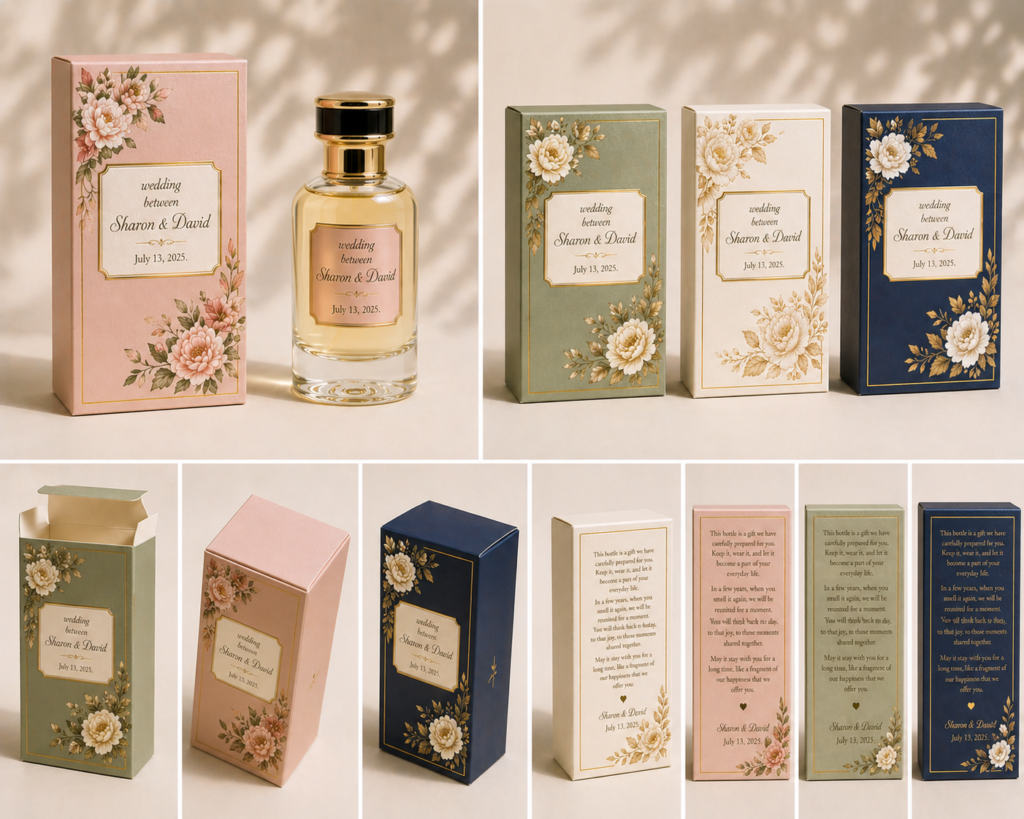
Co-branded labels: hotel logo plus couple’s monogram
Co-branded labels are the structural differentiator between hotels and other venue categories. The label carries two brand layers:
- Hotel layer (front or back panel): “With our compliments — [Hotel Name]” plus the property logo or wordmark.
- Couple layer (front panel): “Smith-Jones Wedding · 14.06.2026” plus an optional monogram.
The couple sees the property logo every time they look at the favor for the next 12–24 months (perfume shelf life under normal storage). Their guests do the same.
Operationally, our custom label program carries zero setup cost and zero plate fees. The hotel uploads its master logo file once (vector preferred — .ai, .eps, or .svg), and we hold the asset on file. For each wedding, the only variable is the couple-layer text, which the hotel’s sales coordinator submits with the BEO 60 days before the event. We turn the artwork proof in 48 hours, the hotel signs off, and we produce.
For multi-property chains, the master logo can be applied across every property’s PO without re-onboarding fees.
On-site inventory management at the banquet hall
Hotel banquet operations run on tight storage discipline. Wedding favors integrate into existing inventory protocols:
- Storage temperature. Eau de toilette and eau de parfum are stable between 5°C and 25°C. The standard hotel banquet stockroom (typically 18–22°C, away from kitchen heat sources) meets this requirement without modification. Avoid storage near steam tables, dishpits, or rooftop HVAC return.
- Stock rotation. Production date appears on the carton lot code. FIFO rotation is standard — oldest lot ships first to the banquet hall floor for any given event. The shelf-life window is 24 months from production, which exceeds the typical 60–90 day pre-event holding period.
- Pre-event count. Banquet captain receipts the favor cartons against the BEO guest count 24 hours pre-event. Standard practice is to deliver guest count plus 5% buffer (e.g., 158 units for a 150-guest wedding) to absorb last-minute additions.
- End-of-event count. Captain reconciles distributed units against returned overage. Returns go back into the property’s wedding-favor sub-stockroom for the next event if the lot is unbranded backup, or are billed to the couple if co-branded (since co-branded inventory is non-fungible).
- Hazmat and shipping classification. Eau de parfum carries a UN1170 / Class 3 limited quantity classification. Our DDP shipments are pre-cleared and arrive at the property’s loading dock with all documentation. The hotel does not handle customs paperwork.
Pricing tiers DDP and wedding-package markup
The two tables below are the working economic model for a hotel’s wedding-package P&L. The first table is our DDP pricing to the hotel; the second is the recommended package markup based on the n=63 benchmark.
Table 1 — Wedding Perfume Favors DDP wholesale pricing (per unit, delivered to hotel loading dock):
| Volume tier | MOQ (units) | Per-unit DDP cost | Format options |
| Entry | 100 | $9.00 | 15ml EDT, custom label |
| Standard | 250 | $6.50 | 15ml EDT/EDP, custom label |
| Volume | 500 | $5.20 | 15ml/30ml, custom label, gift box |
| Bulk | 1,000+ | $4.50 | Full format range, full co-branding |
| Chain | 5,000+ | $3.90 | Negotiated, multi-property consolidation |
Table 2 — Hotel wedding-package markup model:
| Hotel package tier | Per-unit DDP cost | Hotel markup x | Per-favor wedding-package price | Net hotel margin |
| Standard | $4.50 | 2.2x | $9.90 | $5.40 |
| Premium | $6.50 | 2.5x | $16.25 | $9.75 |
| Luxury | $9.00 | 2.8x | $25.20 | $16.20 |
| Couture | $12.00 | 3.0x | $36.00 | $24.00 |
For a 150-guest wedding at the Premium tier, the contribution is 150 x $9.75 = $1,462.50 net margin per event, against a $975 cost of goods. The Couture tier on the same guest count delivers $3,600 net margin per event.
Lead time vs hotel booking calendar
Hotel wedding sales cycles are long. The typical couple signs the venue contract 9–14 months before the wedding date, with the BEO finalized at 60 days. Our production lead time aligns to this calendar:
- Day 0 — couple signs wedding contract: the favor SKU appears on the package they signed.
- Day -120 — BEO draft: sales coordinator confirms favor tier, quantity estimate, and co-branding text.
- Day -90 — favor PO issued to us: hotel issues PO with confirmed quantity (allowing 10% upward flex for late RSVPs).
- Day -88 — artwork proof: we deliver the co-branded label proof within 48 hours.
- Day -85 — proof sign-off: hotel sales coordinator confirms.
- Day -75 — production complete: 14-day production window from sign-off.
- Day -60 — DDP delivery to property loading dock: hotel receives, inspects, stocks.
- Day -1 — banquet hall pre-stage: captain pre-counts and stages.
The 14-day production window is firm for orders at or below 1,000 units. Larger orders (1,000–5,000 units) extend to 21 days. Multi-property chain orders consolidating across 5+ properties run on a 28-day window with one production batch.
Net 30 terms for hotels with confirmed booking volume
For hotel accounts with 10 or more confirmed weddings per year under contract, Net 30 terms are available after a credit review. Documentation required:
- 12 months of confirmed wedding contracts (BEOs or signed agreements).
- Property D-U-N-S number or equivalent business credit reference.
- Brand or owning-group reference (Marriott, Accor, IHG, Hilton, independent group, etc.).
For opening orders (first PO with the property), terms are 50% deposit at PO, 50% on delivery. Once the second order is placed and the first invoice is settled clean, the account moves to Net 30 automatically. Multi-property chains can establish a master Net 30 facility at the corporate level that flows to all properties under one tax ID.
Multi-property chain consolidation: single PO across properties
Hotel groups operating 3+ banquet-capable properties achieve material savings through consolidated POs. The mechanics:
- Single PO, multi-destination DDP. One purchase order covers favors for properties A, B, and C, with split-destination DDP shipping. Each property receives its own carton with its own BEO reference and customs entry.
- Brand-level co-branding template. The chain master template (logo, brand colors, brand voice on the “compliments” line) is held on file once. Each property’s individual weddings draw from the same master.
- Volume-tier pricing aggregated. A chain ordering 4,000 units across 8 properties qualifies for the 1,000+ Bulk tier ($4.50 DDP), not 8 separate Entry-tier orders at $9.00. The savings on a 4,000-unit annual volume: $18,000.
- One customs entry per property. DDP means we handle the customs paperwork at each delivery point. Hotels do not file entries.
- Consolidated invoicing. One monthly invoice to the chain corporate office, with line-item attribution to each property’s GL.
Mid-pipeline ready to scope your wedding-package SKU? WhatsApp +33 6 17 74 77 13 for a property-specific quote and Net 30 application.
Why Wedding Perfume Favors fits hotel banquet operations
Six structural fit points for hotel procurement:
- IFRA Amendment 51 compliance pack. All formulas comply with the most recent IFRA amendment, with documentation provided at PO. Hotels reselling across EU, UK, US, and APAC borders carry the same compliance dossier — no per-jurisdiction reformulation.
- ISO 22716 GMP manufacturing. Made in France in an ISO 22716–certified cosmetic GMP facility. Audit-ready documentation available for hotel groups whose corporate compliance teams require supplier qualification.
- Single-supplier multi-property consolidation. One vendor onboarding, one master service agreement, one billing relationship across the chain.
- Net 30 terms for established accounts. Cash-flow-friendly for properties running multiple weddings per quarter with delayed couple payments.
- DDP one-customs-entry per property. No customs brokerage required on the hotel side. We are importer of record at delivery.
- Dropshipping direct-to-banquet-hall. For one-off destination weddings or properties without central receiving, we ship directly to the banquet hall with the BEO reference on the carton label.
Common mistakes hotels make sourcing wedding favors in 2026
Five recurring procurement errors observed across the n=63 benchmark:
- Ordering through 3 different brokers across 3 properties. Multi-property groups frequently end up with one broker per property, tripling customs entries, hazmat handling fees, and accounts-payable workload. Consolidation onto a single supplier with split-destination DDP eliminates 60–70% of this overhead.
- Skipping co-branded labels. When the favor carries only the couple’s name, the hotel forfeits 150 brand impressions per event. Co-branding is a zero-setup-cost feature that converts the favor from a couple’s keepsake to a hotel marketing asset.
- Treating the favor as a couple-sourced item rather than a package SKU. Hotels that allow couples to bring favors from third-party vendors lose the entire margin layer ($600–$900 per event at Premium tier) and accept inbound logistics risk (couple’s vendor delivers late, wrong quantity, damaged goods).
- Underestimating shelf-life and over-ordering. Some properties order a 12-month forward inventory buffer thinking they can use unsold stock for future weddings. Co-branded inventory is non-fungible — the next wedding has different couple text. Order to the BEO confirmed quantity plus 5%, not to a forecast.
- Failing to align favor PO timing with the BEO at -60 days. Late POs (under 45 days pre-event) compress the production and shipping window and force air-freight surcharges or partial deliveries. The 60–90-day PO window is the operational sweet spot.
What this means for your banquet operations
Three concrete actions for the F&B director or banquet purchasing manager reading this:
- Quantify the prize on your existing book. Multiply your confirmed weddings for the next 12 months by your average guest count by the Premium-tier net margin ($9.75). That number is your achievable annualized contribution from a single SKU addition.
- Run a 90-day pilot on 3 weddings. Add the favor as a line item on three upcoming BEOs — one Standard, one Premium, one Luxury. Measure couple acceptance rate, guest sentiment, and net margin captured. Use the pilot data to write the chain-wide rollout business case.
- Establish the supplier relationship before the next wedding sales cycle. The hotel sales team is selling weddings 9–14 months forward. Lock in DDP pricing, co-branding artwork, and Net 30 terms now so the favor SKU is on the package menu for the next contract signing.
Final CTA
For hotel F&B and banquet purchasing managers ready to integrate wedding perfume favors into the package menu: WhatsApp +33 6 17 74 77 13 for a property-specific quote, co-branding artwork samples, Net 30 application, and multi-property consolidation pricing. Or submit your specifications via request a quote and a hotel account manager will respond within 24 business hours.
MOQ 100 units. 14-day production. Made in France. IFRA Amendment 51 and ISO 22716 compliant. Custom co-branded labels at zero setup. DDP delivery to your loading dock or directly to the banquet hall. Net 30 terms for accounts with 10+ confirmed weddings per year.
Continue your research
- Wedding Perfume Favors — pillar overview
- Bulk Perfume Favors for Wedding Venues — broader venue category
- Wedding Planner Perfume Favors — planner-hotel partnerships
- Wholesale Wedding Perfume Favors — Net 30 terms detail
- Event Companies Perfume Favors
- Bulk Wedding Perfume Favors