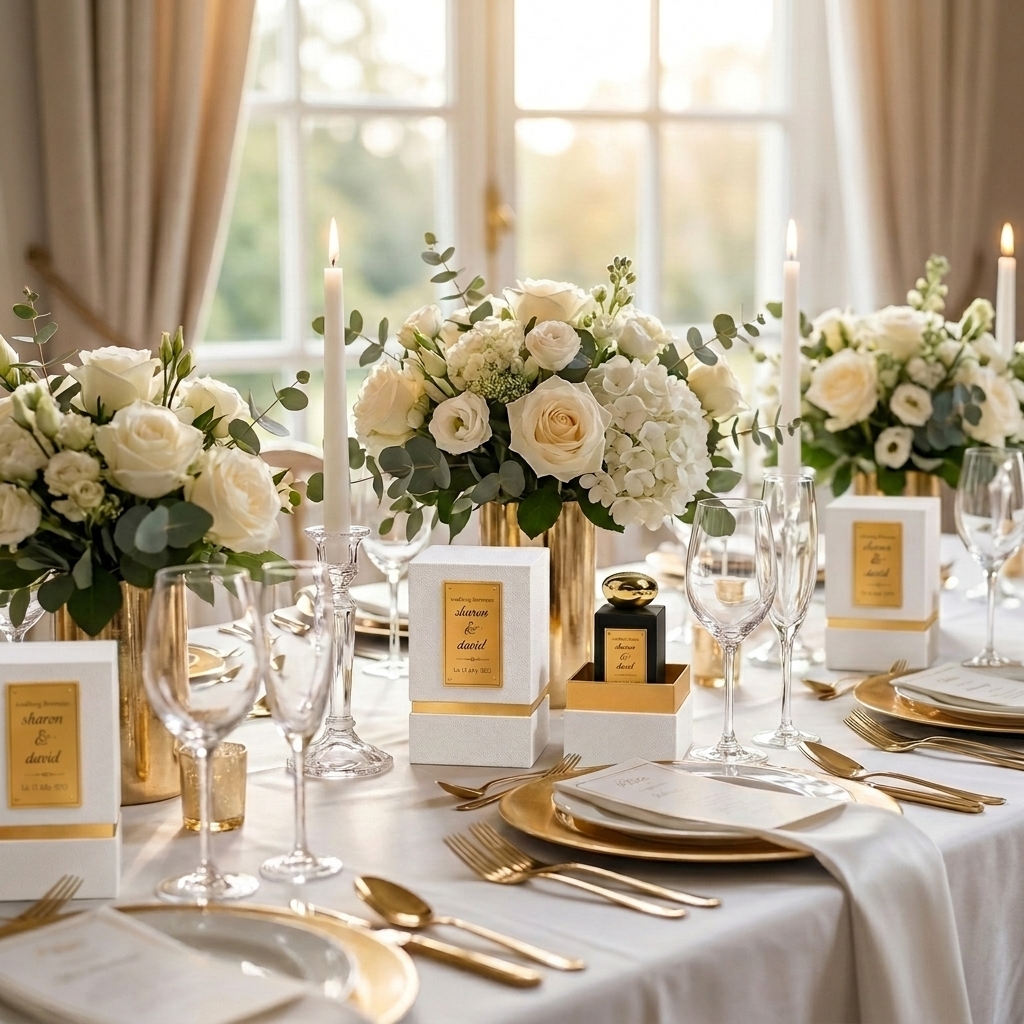
Wedding venues hosting 25 to 80 weddings per year integrate bulk fragrance favor into their venue wedding package, generating $14,000 to $48,000 incremental annual revenue at 60 to 75 percent margin. Annual program MOQ at 1,000 to 2,500 units unlocks $2.40 to $3.40 DDP per-unit pricing, marked up 2.5 to 3.5 times into the venue package — a $4 to $7 net per-favor margin at scale. For châteaux, ballrooms, country estates, vineyard venues, and hotels with substantial wedding business, fragrance favor is no longer a couple-side line item: it is venue inventory, sold through the package, co-branded with the venue mark, and operated as a recurring annual SKU.
Want a venue annual program quote with co-branded label mockups? WhatsApp +33 6 17 74 77 13. Send your projected wedding count for 2026, average guest count, and venue brand assets. We return tier pricing, label mockups carrying both your venue brand and a sample couple identity, and a draft annual PO schedule within one business day.
Why Venues Integrate Fragrance Favor Into the Wedding Package
The shift from couple-sourced favor to venue-package favor reflects four operational realities. First, revenue uplift. A favor sold to the couple inside the venue package at $9 to $14 per guest, against a DDP landed cost of $2.40 to $3.80, produces a contribution margin venues capture without raising headline package pricing — the favor is bundled into the per-cover or per-package rate, and the couple perceives it as inclusive. On a 120-guest wedding, that is $720 to $1,200 of incremental venue margin per event.
Second, brand reinforcement. Each guest leaves with a fragrance object carrying the venue’s name. Couples archive favors at home for years; a 30 ml roll-on with a vineyard estate’s crest sits on a guest’s dresser for the lifetime of the fragrance. This is venue marketing the couple actively distributes for you.
Third, couple convenience. Couples managing a wedding evaluate roughly 14 to 22 vendor categories. Removing fragrance favor from their sourcing checklist — by including it in the venue package — is a value-add the couple registers immediately during the venue tour. Venue F&B and banquet directors report fragrance favor inclusion as a measurable conversion lever during the booking decision.
Fourth, reduced vendor coordination workload for venue staff. When the couple sources favors from a third party, venue banquet teams must accept delivery, store the goods, count them, place them at table or station, and reconcile leftovers. When the favor is venue inventory, that workflow is internal — your team owns the SKU, the storage location, and the placement protocol, with no external vendor to chase. The couple’s planner contacts you, not a fragrance supplier.
Co-Branded Labels: Venue Identity Plus Couple Identity
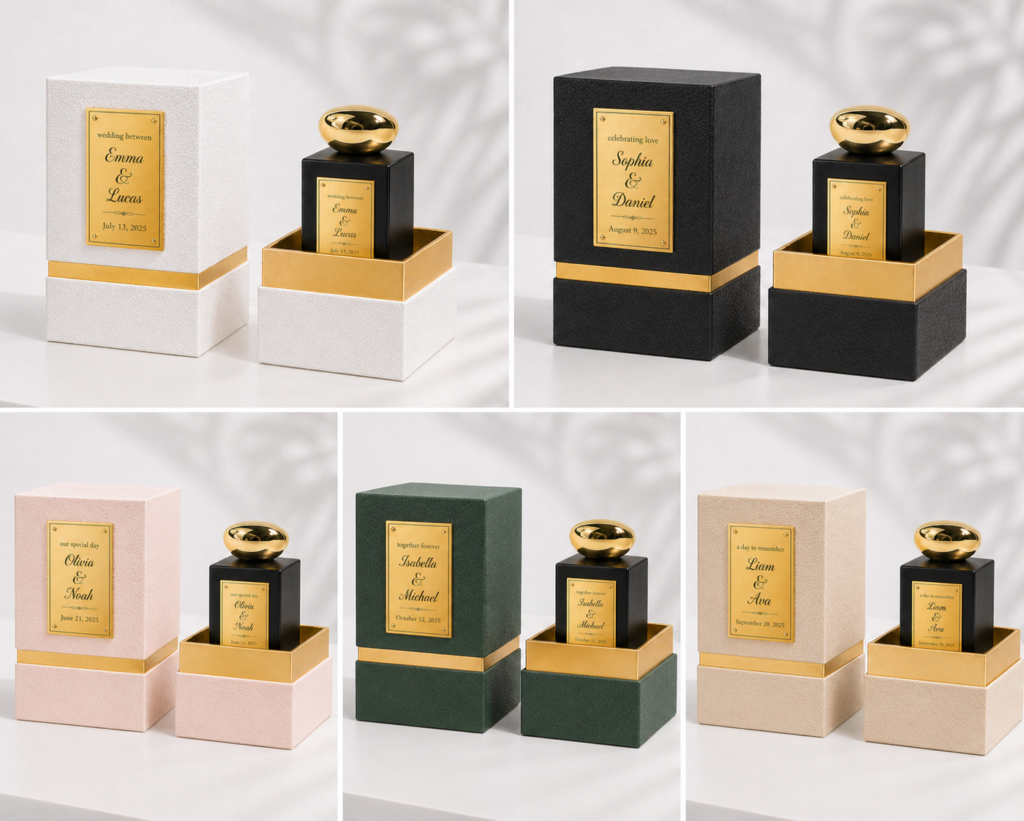
Co-branding is the structural difference between venue-package favor and couple-sourced favor. The label carries two layers of identity: a fixed venue layer (logo, venue name, optionally a small heritage line such as the founding year or estate name) and a variable couple layer (couple first names, wedding date, optionally a monogram or motif).
A typical layout reads: “Château de Chantilly · Smith Wedding · 14.06.2026” or “Domaine de Valmer Vineyards · Lopez & Chen · 22.08.2026”. The venue mark sits at the top, the couple identity sits below, and the back label carries IFRA compliance, fragrance composition, and country-of-origin marking required for resale.
Setup cost on co-branded labels is zero in our standard program. Once the venue master template is locked — typically a one-time design alignment session — each new wedding triggers only the variable layer update. There is no per-event plate fee, no minimum reset, and no design surcharge. The venue master file lives on our side; couples send their names and date through the venue’s intake form, and your account manager pushes the variable update into production.
Brand visibility post-event extends 5 to 10 years. Fragrance favors, unlike printed paper or perishable items, travel home, stay shelved, and continue to display the venue mark. For a venue investing in long-term referral economics — friends of guests touring two years later — co-branded fragrance favor is a low-cost continuity asset.
Annual Venue Program MOQ Patterns
The cost difference between event-by-event sourcing and annual-program sourcing is the central economic argument for venue procurement.
A venue hosting 30 weddings per year, averaging 110 guests, consumes roughly 3,300 favor units annually. Sourced event-by-event at MOQ 100, each PO sits at the entry tier — call it $4.20 to $4.60 DDP per unit. Aggregated into a single annual program at MOQ 3,300, the same volume drops into the 2,000 to 4,000 tier at $2.80 to $3.40 DDP. The unit saving is $1.20 to $1.60. Across the year, that is $3,960 to $5,280 of pure margin recovery, before any markup.
Annual MOQ aggregation works through a release schedule. The venue commits to total annual volume — say 3,000 units — and releases against that commitment in waves: an initial production wave of 1,500 covering the first six months, a second wave of 1,000 covering months seven through ten, a closing wave of 500 covering the year-end book. Pricing locks at the annual-volume tier from the first release. Variable couple labels update per release wave, batched against the confirmed wedding book at the moment of release.
Venues hosting 40-plus weddings cross into the 4,000 to 8,000 unit band, where DDP lands at $2.40 to $2.80. Multi-property groups managing 3 to 8 venues consolidate annual volume across all properties on a single PO, reaching the 8,000-plus tier and unlocking the lowest unit pricing in the program.
Pricing Tiers — DDP Landed
| Quantity | Format | Per-unit DDP | Production lead time |
| 100–249 | 30 ml roll-on | $4.80–$5.60 | 14 days |
| 250–499 | 30 ml roll-on | $4.20–$4.80 | 14 days |
| 500–999 | 30 ml roll-on | $3.60–$4.20 | 14 days |
| 1,000–2,499 | 30 ml roll-on | $2.90–$3.40 | 14–18 days |
| 2,500–4,999 | 30 ml roll-on | $2.50–$2.90 | 18–21 days |
| 5,000+ | 30 ml roll-on | $2.20–$2.50 | 21–28 days |
Pricing is DDP — duties, taxes, and customs clearance into the destination country are included. No surprise brokerage invoice on receipt.
Venue Annual Program — Volume Tiers and Package Economics
| Venue annual program | Annual MOQ | Per-unit DDP | Venue package markup | Net per-favor margin |
| Boutique (10–20 weddings) | 1,000–2,000 units | $3.40–$3.80 | 2.5× | $5.00–$5.70 |
| Standard (20–40 weddings) | 2,000–4,000 units | $2.80–$3.40 | 2.8× | $5.20–$6.20 |
| Major (40–80 weddings) | 4,000–8,000 units | $2.40–$2.80 | 3.0× | $4.80–$5.60 |
| Group / multi-property | 8,000+ units | $2.20–$2.60 | 3.0–3.5× | $5.30–$6.80 |
The package markup column reflects the position fragrance favor occupies inside the per-guest venue package — typically bundled into the welcome amenity, the gift table, or the place-setting line. Markup discipline at 2.5 to 3.5 times keeps the line invisible against couples shopping competing venues, while preserving venue contribution.
On-Site Inventory at the Venue
When the favor lives in venue inventory, storage and batch discipline become operational responsibilities of the venue F&B or banquet team. Three protocols matter.
Storage temperature: fragrance product holds best between 15 and 25 degrees Celsius (59 to 77 Fahrenheit), away from direct sunlight and away from active heating ducts. A dry storage room, a wine-adjacent cellar zone in vineyard venues, or a climate-controlled banquet stockroom all qualify. Storage life on properly held inventory exceeds 24 months — well beyond any annual program release cycle.
Batch tracking by event: each production wave ships with a batch identifier on the carton and on the unit back-label. Banquet teams record the batch against the wedding event in the venue’s event-management system. If a couple later raises a question, the batch traces back to a specific production wave and IFRA documentation set.
End-of-event count reconciliation: post-event, leftover units are recounted against the headcount actually served. Variance reconciles into the next event’s allocation — a low-loss SKU when handled with normal banquet inventory discipline.
Carton-level palletization on annual program releases drops directly to the venue receiving dock. We coordinate delivery windows with your receiving manager.
Net 30 Terms for Venues With 10-Plus Confirmed Weddings
Venues with a confirmed annual book of 10 or more weddings qualify for Net 30 payment terms after a one-time account opening. The opening package is light: business registration document, banking reference or trade reference, and the projected annual wedding count. Approval typically returns within five to seven business days.
Net 30 lets venues align fragrance favor cost against the deposit and final-payment cycle of the underlying wedding bookings. A wedding paying its venue final balance 14 days before the event will have already cleared inside the same 30-day window the favor invoice falls within — meaning the favor is effectively self-financing against the couple’s payment schedule.
For larger annual programs, we structure release-by-release invoicing. Each production wave invoices on shipment, payable Net 30 from invoice date. Cash flow stays predictable; no single large balloon invoice hits the venue accounts payable cycle.
Ready to open a venue annual program account? WhatsApp +33 6 17 74 77 13 with your venue name, property count, and projected 2026 wedding volume. We return account opening forms, draft annual MOQ recommendation, and Net 30 eligibility within one business day.
Multi-Venue Group Consolidation
Venue management groups operating 3 or more properties — hotel groups with multiple wedding-active hotels, château collections, vineyard estate groups, ballroom operators with regional portfolios — consolidate annual programs across all properties onto a single PO.
Mechanically, the group purchasing manager submits one annual forecast covering all properties. Each property nominates its own variable label master (its own logo and venue name), and the variable couple layer flows from each property’s individual wedding book. Production runs are batched across properties on a unified release calendar, but pallet shipments split per destination property.
The unit pricing benefit comes from total group volume reaching the 8,000-plus tier. Even if no single property would qualify for that tier independently, the group consolidation pushes aggregate volume into the lowest band. Customs clearance, hazmat documentation, and IFRA compliance paperwork issue once at group level rather than property by property — a measurable overhead saving for group procurement teams.
A group operating 5 properties at 25 weddings each averaging 110 guests aggregates to roughly 13,750 units annually. At the group tier, that is $30,250 to $35,750 DDP landed. At a 3.0 times package markup, the group resells $90,750 to $107,250 of inclusive favor revenue against $30,000 of cost — a contribution of roughly $60,000 to $77,000 across the group annually.
Lead Time Versus the Venue Booking Calendar
Couples book wedding venues 9 to 14 months in advance. Wedding favor production runs in 14 days for standard tiers, extending to 18 to 28 days at higher annual volumes. The lead-time gap between venue booking and favor production is large, which lets venues run two valid procurement rhythms.
Rhythm one — event-paced PO. Each event triggers a label release 60 to 90 days before the wedding date. Production fits comfortably inside that window. This rhythm suits boutique venues with irregular booking patterns or seasonal calendars where annual volume forecasting is less reliable.
Rhythm two — quarterly rolling PO. The venue places quarterly POs covering a rolling 3-month forward event book. At the start of each quarter, the venue confirms the next 90 days of weddings, batches the variable label data into a single release, and receives a single consolidated shipment. This rhythm suits venues with steady annual books — 25-plus weddings per year — and consolidates inbound logistics into 4 deliveries per year rather than 25 to 80.
In either rhythm, annual MOQ tier pricing applies as long as the total annual commitment is in place at the start of the program year. The release cadence is operational; the pricing tier is contractual.
Why Wedding Perfume Favors Fits Venue Annual Programs
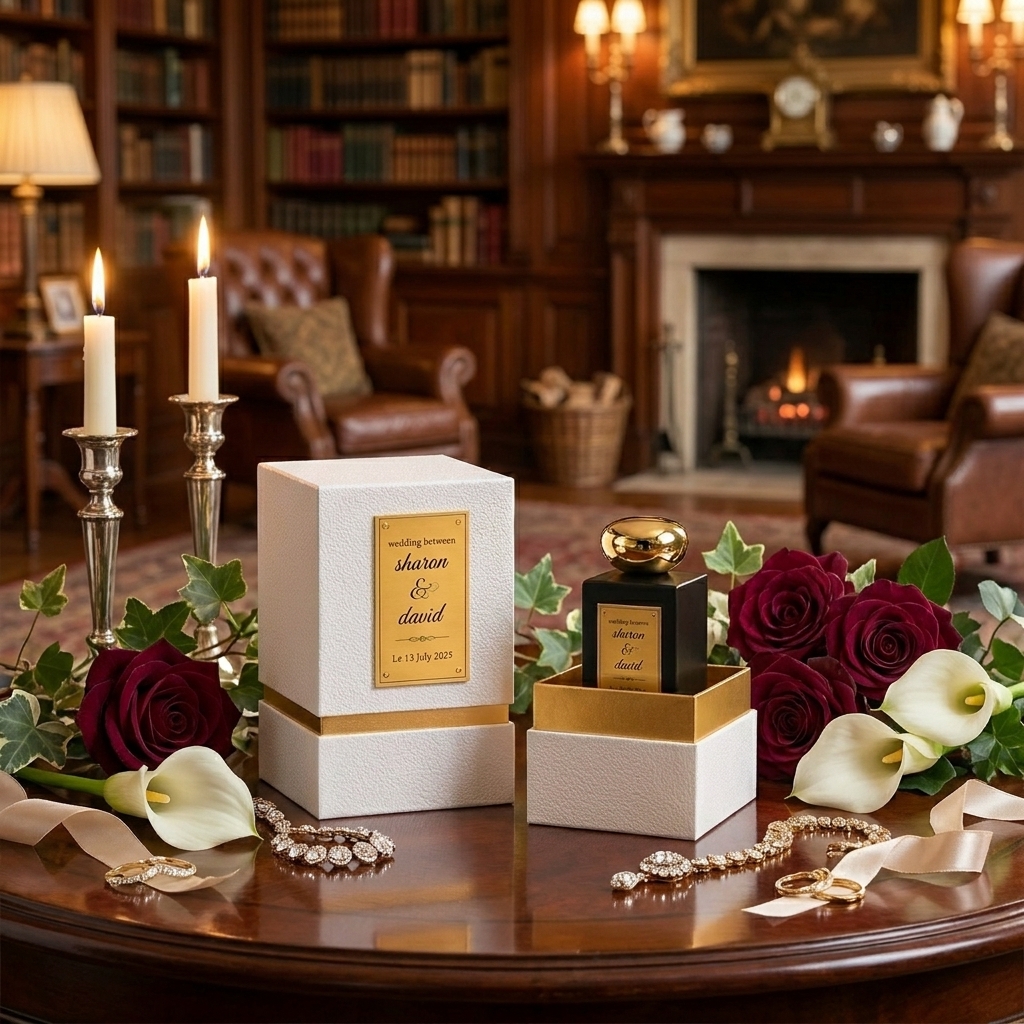
Single-supplier annual PO consolidates customs and hazmat overhead. One IFRA pack, one ISO 22716 cosmetic-GMP certificate, one country-of-origin Made in France declaration, one harmonized tariff classification — issued once at program open, referenced across every release. Venue procurement does not re-document each event.
IFRA and ISO compliance pack supports venue resale liability. When the favor is sold inside the venue package, the venue is the legal reseller. Compliance documentation moves from supplier to venue at PO acceptance, providing the documentation a venue insurer or legal counsel expects on a resold consumer fragrance product. We supply the pack as standard at every annual program open.
Net 30 terms for venues with 10-plus confirmed weddings, structured release-by-release, aligning favor invoice timing with the underlying wedding payment cycle.
Dropshipping for direct-to-banquet delivery. For venues that prefer not to hold inventory, we ship per-event volumes 7 to 10 days before the wedding date directly to the banquet receiving dock, labeled per event, palletized, and tracked.
Co-branded labels at zero setup — venue master template plus variable couple layer, no per-event plate fee, no minimum reset, no design surcharge after the initial template alignment.
Catalogue access of 1,000-plus references means venues can offer couples a curated short-list (typically 6 to 12 fragrances) inside the venue package, with the venue selecting the catalogue subset that matches its brand positioning — vineyard venues leaning to vinous and woody profiles, château venues to floral and chypre, modern ballrooms to contemporary clean musks.
Common Mistakes Venues Make Sourcing Bulk Favors in 2026
1. Ordering event-by-event instead of annual program. Missing tier-break savings of $0.80 to $1.40 per unit. On a 30-wedding venue, that is $2,640 to $4,620 of margin left on the table annually.
2. Skipping co-branded labels. Couples don’t see the venue reinforce its brand. The favor leaves with the couple’s name only, and the post-event referral asset evaporates.
3. Treating favor as couple-side procurement. Routing the couple to source independently means the venue forfeits the package markup. The same favor that would carry $4 to $7 of venue margin instead carries zero, while the venue still absorbs receiving, storage, and placement workload.
4. Failing to lock IFRA and ISO compliance documentation at PO acceptance. When favor is venue inventory sold inside the venue package, the venue becomes the legal reseller. Without the compliance pack, venue insurance and legal exposure are not properly covered.
5. Under-forecasting annual volume to stay in a lower MOQ band. The lower band is more expensive per unit. Forecasting accurately into a higher tier — even if it requires a small carryover into the following year — lowers per-unit cost and protects margin across the entire program.
What This Means for Your Venue Wedding Package
Action one — model your annual volume. Take your projected 2026 wedding count, multiply by average guest count, and locate yourself on the venue annual program tier table above. This is the number that drives every downstream decision.
Action two — lock co-branded label master. Approve a single venue master template carrying your logo, venue name, and the variable couple layer specification. This template runs the program for the year. Couples never see the back end; the variable update is automatic.
Action three — open Net 30 and schedule release waves. Submit account opening, set release wave dates against your wedding calendar (event-paced or quarterly rolling), and integrate the favor SKU into your venue package collateral so the F&B and banquet teams can reference it consistently in couple consultations.
Open your venue annual program account: WhatsApp +33 6 17 74 77 13 or request a quote. Send your projected 2026 wedding count, average guest count, and venue brand assets. Tier pricing, co-branded mockups, release calendar draft, and Net 30 forms return within one business day.
Continue Your Research
- Wedding perfume favors — pillar guide
- Hotels wedding perfume favors — hotel-specific subset
- Bulk wedding perfume favors — MOQ math deep-dive
- Wholesale wedding perfume favors — Net 30 terms
- Wedding planner perfume favors
- Event companies perfume favors