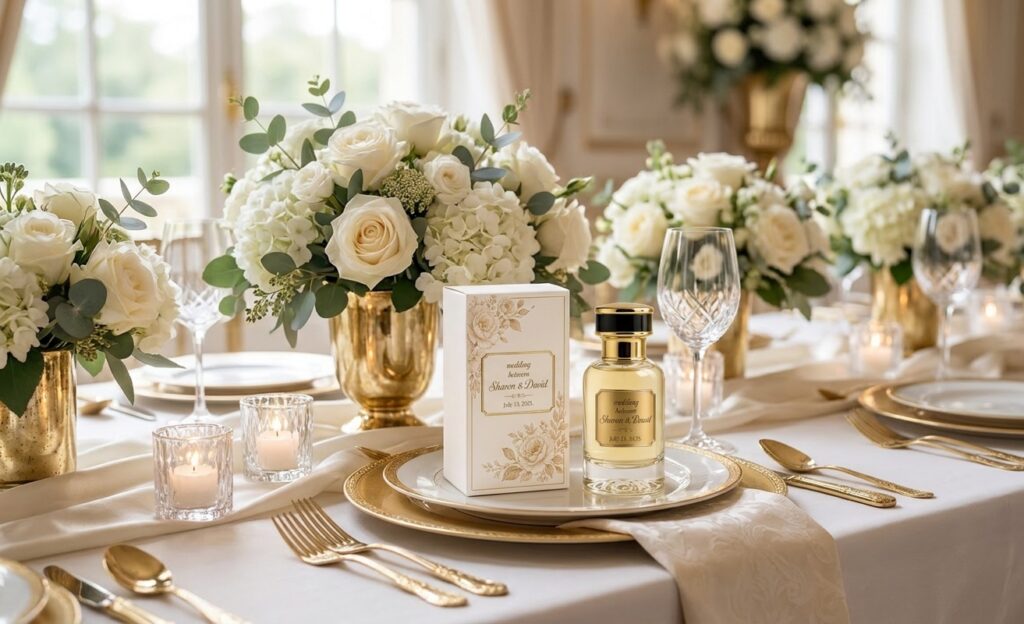
62% of brides in 2024-2025 wore a fragrance on their wedding day specifically chosen for the occasion (not their daily perfume) according to The Knot. The criteria differ from daily wear: 8-hour longevity, moderate-to-strong sillage that survives camera flashes and reception kisses, and a scent profile that won’t clash with bouquet flowers or food. The fragrance you wear that day will become the strongest sensory anchor of the entire experience — in two years, three years, fifteen years, the smell of that bottle will pull you back into the morning of the ceremony faster than any photograph. This guide is about choosing it correctly.
Want a custom 30ml bridal bottle for yourself + bridesmaids? WhatsApp Wedding Perfume Favors at +33 6 17 74 77 13 — 4-SKU split lets you commission a personal bridal scent (50 units for you, the rest as gifts for your wedding party) at $5.50–$7.80 DDP, 14-day production from Grasse, France.
Why your everyday fragrance might not work for the wedding day
Your daily perfume was chosen under conditions that don’t exist on the wedding day. You apply it in the morning, in a stable mood, at a normal body temperature, and you wear it for a four-to-six-hour office stretch. None of that holds on the day you get married.
Skin chemistry shifts under stress. Cortisol rises sharply on the morning of the ceremony. Stress hormones change skin pH, surface oils, and micro-perspiration — which is why brides routinely report that their familiar perfume “smells different” on the wedding day. Sometimes it amplifies (the projection doubles), sometimes it goes flat. A daily fragrance you’ve never tested under that physiological state is a variable you don’t want.
Longevity needs are different. A normal workday perfume is engineered to last six hours. A wedding day timeline is eight to twelve hours, often longer if you count the after-party. Top-note-heavy fragrances (citrus, light florals) collapse by hour three and leave you scentless for the photos.
The photo-memory factor. This is the criterion most brides underestimate. The fragrance you wear that day becomes neurologically tied to the event. Every time you open the bottle in the years that follow, you go back. If your everyday perfume is also your wedding perfume, the association dilutes — every Tuesday spritz overwrites the wedding-day memory. A separate bridal scent preserves the anchor.
The 8-hour wedding day timeline and how fragrances behave
A perfume isn’t one smell — it’s three movements that unfold over hours. Mapping the day to those movements helps you choose:
0–30 minutes (top notes, getting-ready phase). You apply the perfume after the shower, before the dress. The volatile top notes — citrus, aldehydes, light fruit, green leaves — evaporate first. They are what your bridesmaids and your photographer smell during the prep shots. Choose a fragrance whose top notes you actually love being photographed inside, because the makeup-and-robe portraits happen here.
30 minutes – 3 hours (heart notes, ceremony + first photos). The heart blooms as the top burns off. This is the rose, the jasmine, the iris, the peony, the violet, the muguet — the soul of the perfume. The ceremony, the kiss, the recessional, the formal portraits, the cocktail hour all sit inside this window. The heart is what your spouse will smell when they kiss you. Pick this section with intent.
3–8 hours (base notes, reception). The base reveals itself over the reception: musk, sandalwood, vanilla, amber, oakmoss, vetiver, white musk, cashmere woods. This is the dry-down that lingers on the dress and the skin late into the night. It is also what you will smell on your wedding outfit the next morning when you take it off the hanger. The base is the long-tail memory.
A wedding-grade perfume needs all three movements to be intentional. Many daily perfumes are top-and-heart constructions with minimal base — fine for the office, weak for an event.
Olfactive families for brides — what to consider
Five families dominate bridal selection. Each has a different personality and a different photo signature.
Soft floral. Powdery, romantic, slightly retro. Examples: Chloé Eau de Parfum (peony rose), Narciso Rodriguez For Her (musk rose), Jo Malone Peony & Blush Suede. Best for soft, vintage, pastel weddings. Photographs as warm and intimate.
Fresh chypre. Modern, sophisticated, slightly green. Examples: Chanel Chance Eau Fraîche, Hermès Twilly d’Hermès, Diptyque Eau Capitale. Best for contemporary city weddings, garden ceremonies, or brides who don’t want anything sweet. Reads as elegant on camera.
White floral. Lush, opulent, statement. Examples: Tom Ford White Patchouli, Frédéric Malle Carnal Flower, Maison Francis Kurkdjian À La Rose. Best for grand venues, evening receptions, dramatic gowns. Caution: these fragrances have heavy sillage and can clash with white-floral bouquets (see below).
Modern oriental. Warm, spicy, sensual. Examples: YSL Libre, Maison Francis Kurkdjian Baccarat Rouge 540, Guerlain Mon Guerlain. Best for fall and winter weddings, candlelit venues, evening ceremonies. Excellent base-note longevity — these still read on the dress at midnight.
Citrus aldehydic. Crisp, clean, classic. Examples: Chanel No. 5 L’Eau, Acqua di Parma Magnolia Nobile, Penhaligon’s Halfeti. Best for daytime weddings, summer ceremonies, brides who want a “clean bride” signature. Shorter longevity — plan to refresh at hour four.
Sillage and projection — the photo-friendly distance
Sillage is the trail your fragrance leaves behind you; projection is how far it travels from your skin in real time. Both are measurable and both matter for photography.
Moderate sillage (40–60 cm) is the photo-friendly zone. Your photographer is often 30–80 cm from your face for portrait close-ups. At moderate projection, your spouse and the photographer can smell you clearly without the scent dominating the room. This is the sweet spot.
Strong sillage (80 cm+) overwhelms tight portrait shots, irritates the officiant during the vows, and can compete with the catering during dinner. It is also more likely to give the photographer a headache through a full day of close-ups (a complaint they will not voice but will remember).
Light sillage (under 30 cm) disappears during the ceremony — your spouse won’t smell you when you kiss, and the perfume isn’t doing its job as a memory anchor.
A practical rule: two sprays for moderate, three for strong, one for light. Always test on your own skin two months out — projection varies by body chemistry and by ambient temperature. A fragrance that reads as moderate in March projects as strong in August.
How to layer for longevity
A single spray of perfume on dry skin lasts 4–5 hours. A layered application lasts 8–10 hours. Layering is non-negotiable for a wedding day timeline.
The base layer. Apply a matching or unscented body lotion immediately after the shower. Hydrated skin holds fragrance roughly 30% longer than dry skin. If your fragrance house makes a matching body lotion (Chanel, Jo Malone, Guerlain, Diptyque all do), use it. Otherwise, an unscented shea or cocoa butter works.
The oil step. A drop of unscented body oil on the pulse points before perfume creates a slower evaporation surface. The oil traps the fragrance molecules and releases them gradually.
Application points. Inside of wrists, behind the ears, the hollow of the throat, the inside of the elbows, behind the knees (for when you sit during dinner), and one spray into the hair from 30 cm away. Six points total. Avoid spraying directly on the dress — silk, satin, and tulle stain from alcohol-based perfumes, and the stain is permanent.
The hair trick. Hair holds fragrance longer than skin and releases it with every movement. A single mist into the hair is the longest-lasting application point of all, and it’s what your spouse smells when they pull you close.
Bouquet and venue flower considerations
This is the variable most brides forget. Your bouquet is held under your nose for hours. The venue flowers are at every table. If your fragrance is a heavy white floral and your bouquet is heavy white floral, the two will clash and produce a smell neither of you wanted.
Common clashes: – White floral perfume + tuberose/gardenia/lily bouquet = overload, often nauseating by hour three – Rose-dominant perfume + rose-dominant bouquet = the perfume disappears (the bouquet wins) – Citrus perfume + heavily fragranced peonies = the perfume reads as cheap by contrast
Safe pairings: – Soft floral or chypre perfume + white floral bouquet = the bouquet leads, the perfume supports – Modern oriental perfume + green/foliage-heavy bouquet = no olfactive competition – Citrus aldehydic perfume + neutral-scent flowers (orchids, ranunculus) = clean and harmonious
Ask your florist what flowers will be at the altar and on the dinner tables. Smell them in the studio before the day. If the venue florals are aggressive (lilies in particular), pick a perfume that won’t fight them.
Pricing tiers DDP — for brides who want a custom bridal-party run
Many brides commission a personal bridal scent and gift smaller bottles to bridesmaids and mothers. Wedding Perfume Favors operates at the following DDP price points:
| Guest count tier | $/unit DDP (15ml + custom label) | $/unit DDP (30ml + custom label) | Total favor budget |
| 100–149 | $4.50–$6.50 | $5.50–$7.80 | $550–$820 |
| 150–249 | $3.80–$5.50 | $4.80–$6.80 | $720–$1,200 |
| 250–399 | $3.20–$4.50 | $4.20–$5.80 | $1,050–$1,650 |
| 400–599 | $2.80–$3.80 | $3.80–$5.00 | $1,520–$2,400 |
| 600+ | $2.40–$3.40 | $3.40–$4.50 | $1,950+ |
For a private bridal-party order (you + 8 bridesmaids + 2 mothers = 11 bottles), the MOQ of 100 is met by the 4-SKU split: one SKU for the bride’s personal scent in 30ml format, three SKUs for guest favors at the wedding. The bride keeps a 50-unit run of her own scent for personal use and post-wedding refills.
Olfactive family reference table
| Olfactive family | Characteristic notes | Best ceremony timing | Longevity score (1–5) |
| Soft floral | Peony, rose, iris, violet, suede | Daytime, garden, vintage | 3 |
| Fresh chypre | Bergamot, oakmoss, patchouli, green | Spring, city, modern | 4 |
| White floral | Tuberose, gardenia, jasmine, ylang | Evening, grand venue | 5 |
| Modern oriental | Amber, vanilla, spice, sandalwood | Fall, winter, candlelit | 5 |
| Citrus aldehydic | Bergamot, neroli, aldehydes, musk | Summer daytime, beach | 2 |
Test-before-the-day protocol
A wedding day is not a debut. Plan the test sequence:
- Six to eight weeks before, buy a 5–10ml decant of the candidate fragrance.
- Apply it in the morning the way you plan to apply it on the day (lotion + oil + 6 application points).
- Track the curve every hour for 8 hours: top, heart, base, projection, residual on fabric.
- Repeat on a high-stress day (a work presentation, a flight, a heated workout) to observe how the fragrance reacts to cortisol.
- Three weeks before, do a dress rehearsal: full hair, makeup, and a fabric piece similar to your dress fabric (a silk scarf works). Apply, photograph, and check for stains.
- One week before, finalize the bottle. Buy the full size. Practice the application twice.
This protocol catches the three major failure modes: longevity collapse, stress-amplified projection, and fabric staining.
Considering a custom bridal bottle for the bridesmaids? WhatsApp +33 6 17 74 77 13 for the 4-SKU split — bride’s personal 30ml + 3 favor SKUs, all in one production run, 14 days from Grasse.
Why Wedding Perfume Favors works for brides who want a custom bottle
For brides who want their wedding fragrance to be unique — not findable at Sephora, not worn by anyone they know — Wedding Perfume Favors offers a custom production at the same MOQ as a guest favor order:
- 4-SKU split. Within a single MOQ-100 order, the bride can dedicate one SKU (50 units) to her personal bridal scent and split the remaining 150 units across three guest-favor variants. One production, four bottles.
- 30ml personal format. The bride’s bottle is sized for personal use, not a token favor. Foil-stamped “Bride” labels in metallic gold, rose gold, or silver are included.
- 1,000+ reference fragrances, including niche bridal compositions developed in Grasse — soft florals, white florals, modern orientals, fresh chypres. The bride selects the formula; the formula is bottled under her label.
- Made in France, IFRA/ISO compliant, 14-day production timeline, DDP shipping. The bride receives bottles ready to wear, ready to gift.
The economics: at $5.50–$7.80 per 30ml unit, a 50-bottle personal run costs $275–$390 — less than a single bottle of premium niche perfume from a department store, and it lasts the bride for years.
Common mistakes brides make on wedding day perfume in 2026
Five errors I see repeated season after season:
- Wearing a brand-new fragrance for the first time on the wedding day. Untested skin reaction, untested longevity, untested projection. The fragrance might smell like a different perfume on you than it did on the test strip.
- Applying perfume after putting on the dress. Silk, satin, organza, and tulle stain permanently from alcohol-based perfumes. The stain is yellow, visible, and shows up an hour later when it’s too late.
- Over-applying to compensate for nerves. Sillage doubles when you’re stressed — your skin amplifies the fragrance. Three sprays of a moderate fragrance becomes the projection of six sprays. Apply less than you think.
- Choosing a perfume that matches the bouquet too closely. White floral on white floral cancels itself out. The perfume should complement the bouquet, not compete with it.
- Forgetting to bring the bottle to the venue for refresh. The base notes carry, but a top-note refresh before the reception (a single spray on the wrists) re-energizes the projection for the dancing portion of the night.
What This Means for Your Wedding Day
Three actions to take this month:
- Pick your olfactive family before you pick the bottle. Walk into one fragrance store, smell the five families, write down which one made you feel like the bride you want to be on the day. Narrow from there.
- Run the 8-week test protocol. Don’t shortcut it. The test reveals what the bottle won’t tell you.
- Decide whether to buy retail or commission a custom bottle. A retail bottle is faster and proven. A custom bottle is unique to your wedding, lasts beyond it, and gives you a private gift for the bridal party.
The fragrance you choose will outlast the cake, the centerpieces, and the playlist. Choose it as if you’ll smell it for the rest of your life — because you will.
Final note
If you’d like to explore a custom bridal bottle in the 4-SKU split format, WhatsApp Wedding Perfume Favors at +33 6 17 74 77 13 or request a quote at weddingperfumefavors.com/request-a-quote. Made in France, 14-day production, DDP shipping worldwide.
Continue Your Research
- Pillar guide: /wedding-perfume-favors/
- Couple-level wedding day fragrance: /wedding-day-perfume/
- Groom signature cologne: /groom-signature-cologne/
- Signature scent — story angle: /signature-scent-for-couples-wedding/
- Signature scent — crafting angle: /couple-signature-scent-wedding/
- Separate bottles for bride and groom: /custom-wedding-perfume-bride-groom/