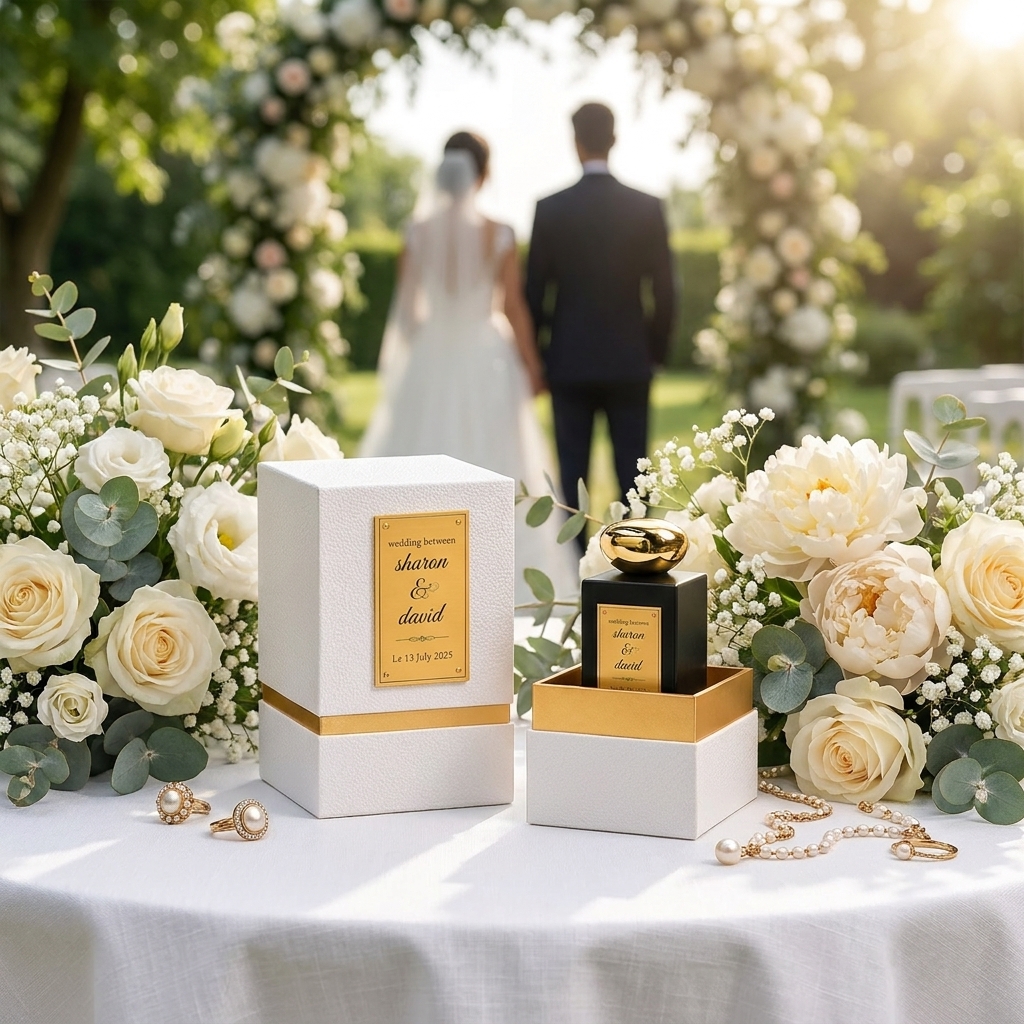
37% of couples in 2025 ordered separate bride-and-groom wedding-day fragrances — distinct bottles, distinct formulas, designed to coexist within 50cm proximity during the ceremony, the first dance and the photo session. This is not a shared couple signature on two skins. This is two individual perfumes, one feminine-leaning, one masculine-leaning, engineered to harmonize without merging. The MOQ 100 / 4-SKU split lets a couple commission 50 bride 30ml bottles ($5.50-$7.80 DDP each) and 50 groom 30ml bottles in one production run for under $1,400, with his/hers labels at zero setup cost. This guide explains the proximity logic, the formulation pairings, the math and the labels.
Ready to brief two complementary scents? WhatsApp us at +33 6 17 74 77 13 or request a quote.
Why two bottles instead of one couple-shared scent
A shared couple signature — the same juice on both partners — is one valid path, and we cover it in our signature scent for couples wedding story-arc piece and our couple signature scent wedding crafting walkthrough. But many couples want something else: two distinct olfactive identities, individually authored, that recognize each other when the wearers stand close.
The reasoning is sensory. When two people embrace, when they pose cheek-to-cheek for a photographer, when they whisper vows at 30cm, the nose receives a layered impression. If both partners wear the exact same perfume, the layered impression is simply a louder version of one scent. If they wear two scents that were never designed to meet, the layered impression can feel chaotic — citrus fighting tobacco, jasmine fighting leather, sweet fighting smoky.
The custom bride-and-groom approach sits between those poles. Each partner gets a perfume that reads as their own: the bride’s bottle is hers from the engagement dinner through the honeymoon, the groom’s bottle is his. But both formulas share at least one bridge note — a vetiver, an amber, a musk, a bergamot — that lets the two compositions occupy the same air without dissonance. The result is a sensory portrait of two people, not one merged identity.
This is also a portrait that lasts. Each partner keeps their bottle after the wedding. Twenty years on, two scents on a shared dresser still tell the story of one day.
Bride’s olfactive profile vs groom’s olfactive profile
Conventionally, fragrance houses have steered “feminine” perfumes toward florals, fruits, gourmand and powdery notes, and “masculine” perfumes toward woods, aromatics, leather and fougère structures. These are conventions, not rules. Plenty of brides wear leather and oud beautifully; plenty of grooms wear iris and jasmine with grace. Gender-fluid options are entirely on the table — and our perfumers brief without assumption.
That said, here are the families couples most often request when commissioning two distinct bottles:
For the bride (conventional): – Soft floral: peony, rose, jasmine, lily-of-the-valley, white musk – Chypre: bergamot top, mossy and patchouli base, often with a floral heart – Oriental / amber: vanilla, benzoin, amber, sometimes oud or saffron – Aldehydic powdery: iris, violet, ambrette, a clean classical structure
For the groom (conventional): – Woody: cedar, sandalwood, vetiver, sometimes guaiac or cypress – Fougère: lavender, oakmoss, coumarin — the architecture behind most masculine classics – Aromatic: rosemary, sage, bay, juniper, paired with citrus – Leather / smoky: birch tar, cade, suede, tobacco
Gender-fluid territory (either partner): – Iris, neroli, vetiver, bergamot, fig, mate, ambrette, white tea, incense
The brief is yours. We have made grooms in tuberose and brides in oud-leather, and they were spectacular. The point is that each bottle is authored individually, then checked against its partner for compatibility.
Building complementary pairs that coexist
The technical work happens in the bridge. Once a bride’s profile and a groom’s profile are sketched, our perfumers identify one or two shared anchor notes that appear in both formulas — often in the base, sometimes in the heart. That shared note becomes the olfactive handshake.
Common bridge notes include: – Vetiver — earthy, smoky-clean, anchors a peony floral and a cedar woody equally well – Amber — warms a vanilla bride and a tobacco groom into the same room – White musk — smooths edges, lets a chypre and a fougère sit together – Bergamot — a citrus opening that flatters most floral and most aromatic structures – Iris — powdery, gender-neutral, elegant in both directions – Sandalwood — creamy wood, friendly to florals and to leather
Beyond bridge notes, perfumers also balance intensity. Two scents at the same projection level (say, both eau-de-parfum-strength at 18%) coexist better than a quiet floral against a roaring oud. We typically tune the bride and groom formulas to comparable diffusion so that neither dominates the photograph.
Five example bride-and-groom pairings
Below are five compositions our team has briefed for couples in 2025-2026. Each one is two distinct juices linked by a deliberate bridge.
- Garden Wedding — Bride: peony, iris, white musk. Groom: vetiver, cedar, leather. Bridge: white musk softens both bases. Theme: countryside chateau, June.
- Mediterranean — Bride: bergamot, jasmine, vanilla. Groom: bergamot, lavender, sandalwood. Bridge: bergamot top in both bottles. Theme: coastal sunset, late summer.
- Winter Cathedral — Bride: rose, saffron, amber. Groom: incense, oud, amber. Bridge: amber in the deep base. Theme: candlelight ceremony, December.
- Modern Minimalist — Bride: ambrette, fig, iris. Groom: mate, vetiver, iris. Bridge: iris in both hearts. Theme: gallery wedding, gender-fluid styling.
- Tropical Destination — Bride: tuberose, coconut, sandalwood. Groom: lime, cardamom, sandalwood. Bridge: sandalwood base. Theme: beach ceremony, Bali or Tulum.
These are not menu items — they are starting points. Your brief can borrow, swap, or invert them entirely.
Format and bottle distinction
The 30ml format is favored for personal couple bottles (the smaller 10ml and 15ml sizes are for guest favors, which is a different program). At 30ml, each partner has roughly six months of daily wear, or several years of occasion wear — enough that the wedding fragrance becomes a recurring ritual.
Couples typically choose between two presentation strategies:
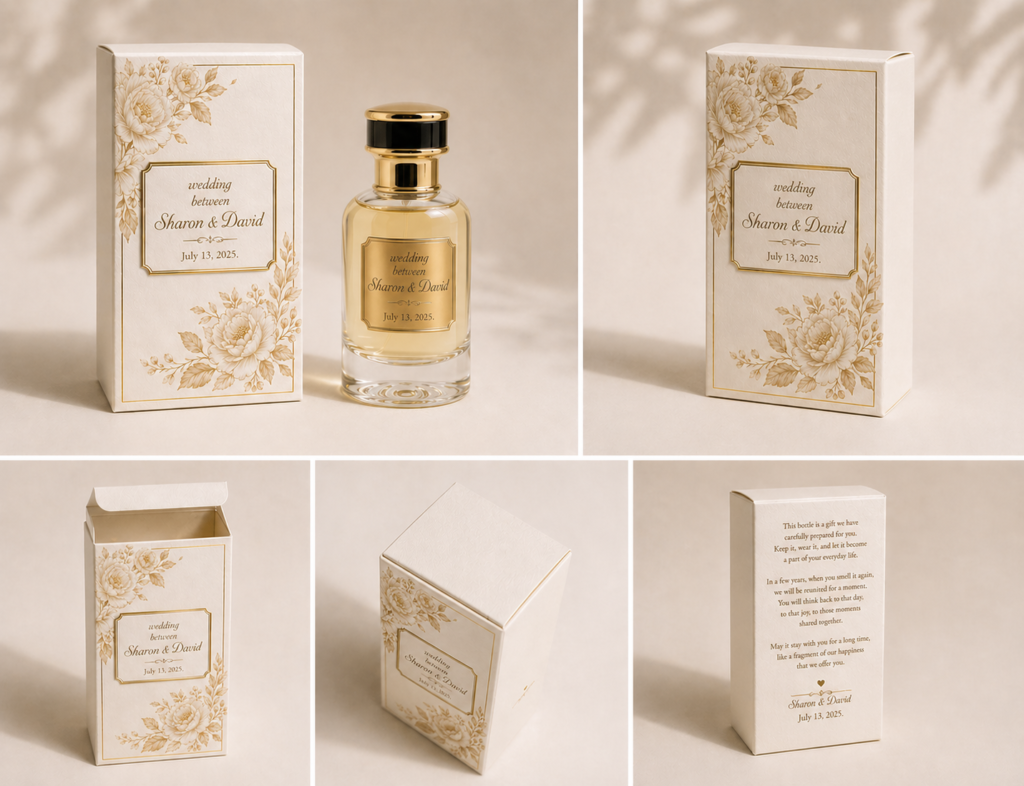
- Visually distinct bottles: the bride wears a frosted or tinted 30ml flacon, the groom wears a clear or smoked-glass 30ml. Same shape, different finish — the dressing-table tells the story at a glance.
- Matching bottles, his/hers labels: identical 30ml flacons, identical caps, but the labels read “Hers” and “His” (or “Mrs.” and “Mr.”, or initials, or full names). Cleaner, more editorial.
Bottle finishes available in our 30ml line include clear, frosted, smoked grey, satin black and matte white. Caps come in wood, metal, ceramic and glass. We pair these freely.
MOQ 100 / 4-SKU math: 50 bride + 50 groom + optional parents-of
The minimum order is 100 bottles, splittable across up to 4 SKUs. For a bride-and-groom program, the natural split is:
- 50 bottles bride formula, 30ml, frosted glass, “Hers” label
- 50 bottles groom formula, 30ml, clear glass, “His” label
That uses 2 of the 4 available SKUs and hits MOQ exactly. The remaining 2 SKU slots can stay unused, or you can extend the program:
- +25 bottles “Mother of the Bride” in a third formula (often a softer floral)
- +25 bottles “Father of the Groom” in a fourth formula (often a quieter woody)
That second option pushes you to 150 bottles total across 4 SKUs and turns the program into a family heirloom set. Some couples gift the parental bottles as a thank-you on the morning of the wedding.
For couples who only want personal bottles (not favors), the 50+50 split at exactly 100 bottles is the lean entry point. The “extra” 49 bride and 49 groom bottles beyond what the couple personally needs become wedding gifts to the bridal party, witnesses, parents, and close friends — each labeled and presented as a memento.
Pricing tiers DDP (verbatim)
| Quantity (per SKU) | 30ml DDP unit price | Notes |
| 50 (e.g. 50 bride + 50 groom = MOQ 100) | $7.20-$7.80 | Standard MOQ split |
| 75 per SKU (150 total) | $6.50-$7.10 | Includes parents-of extension |
| 100 per SKU (200 total) | $6.00-$6.40 | Bridal party + family |
| 150 per SKU (300 total) | $5.80-$6.10 | Larger guest gifting |
| 250+ per SKU | $5.50-$5.80 | Volume tier |
Pricing is DDP (Delivered Duty Paid) — duties, taxes and shipping included to your door. 50% deposit, 50% before shipping. 14-day production after brief sign-off. Made in France, IFRA Amendment 51 compliant, ISO 22716 certified.
Custom labels — “Mr.” and “Mrs.”, initials, or full names
Labels are zero-setup. We print directly to the bottle or apply a high-end adhesive label, your choice, and there is no extra fee for splitting bride/groom artwork. Common label conventions:
- “Hers” / “His” — gender-neutral, modern
- “Mrs. [Surname]” / “Mr. [Surname]” — traditional, formal
- “[First initial] & [First initial]” — minimal, often paired with the wedding date
- Full names — “Eleanor” / “James”
- Phrase + role — “The Bride, June 14 2026” / “The Groom, June 14 2026”
Typography is custom: serif, sans, script, hand-drawn. Foiling (gold, silver, copper, rose) and embossing are available at a small upcharge. We send digital proofs before any ink touches a bottle.
Two formulas, one production run, his/hers labels at no extra cost — WhatsApp +33 6 17 74 77 13 or request a quote.
Five example bride-and-groom pairings (reference table)
| # | Bride profile | Groom profile | Bridge note | Best for theme |
| 1 | Peony + iris + white musk | Vetiver + cedar + leather | White musk | Garden / countryside chateau |
| 2 | Bergamot + jasmine + vanilla | Bergamot + lavender + sandalwood | Bergamot | Mediterranean / coastal sunset |
| 3 | Rose + saffron + amber | Incense + oud + amber | Amber | Winter cathedral / candlelight |
| 4 | Ambrette + fig + iris | Mate + vetiver + iris | Iris | Modern minimalist / gender-fluid |
| 5 | Tuberose + coconut + sandalwood | Lime + cardamom + sandalwood | Sandalwood | Tropical destination / beach |
Why Wedding Perfume Favors fits bride-and-groom custom programs
Four reasons couples commission two-bottle programs with us specifically:
- MOQ 100 with 4-SKU split — the only structure on the market that lets you commission two genuinely different formulas (not two labels on the same juice) without ordering 500 bottles per side. The 50+50 split hits MOQ exactly.
- His/hers labels at zero setup — we treat split-label artwork as standard, not as a custom-tooling line item. Two labels, one price.
- Niche-quality pairings — our perfumers come from Grasse and the Paris ateliers. They have built bride-and-groom pairs for weddings from Tulum to Tokyo. Bridge-note logic is part of every brief.
- IFRA Amendment 51, ISO 22716, Made in France, DDP global shipping — the regulatory and logistical layer is fully handled. You receive two compliant fragrances at your door, duties paid, in 14 days from brief sign-off.
Common mistakes couples make with separate bride-and-groom perfume in 2026
- Picking two scents that fight each other within 30cm proximity. Couples pick a bride scent they love and a groom scent they love and never test them together. Result: the photo proximity is olfactively chaotic. Always check the pair side by side at conversational distance.
- Ignoring the shared bridge note. Without an anchor, two strong but unrelated compositions read as competing rather than complementary. Even a small shared base note (a touch of musk, a whisper of vetiver) is enough to make the pair sit right.
- Mismatched intensities. A delicate iris floral on the bride against a thunderous oud-leather on the groom means only one person’s fragrance gets noticed. Tune both to similar projection.
- Treating the bottles as identical. If both partners want their own scent, both partners deserve their own bottle finish or label. Identical packaging undermines the “two distinct identities” premise. Either visually distinguish, or label-distinguish.
- Confusing this with a shared couple signature. If what you really want is one scent that tells the story of you both on one or both skins, that’s a different project — see signature scent for couples wedding for the narrative approach and couple signature scent wedding for the crafting process. Two-bottle programs and one-scent programs solve different desires.
What This Means for Your Wedding
- Decide whether you want two bottles or one shared scent. This blog is for the two-bottle path. If you want one shared narrative scent, the linked story-arc and crafting articles are the right starting point.
- Sketch the bride profile and the groom profile in plain language first. “Soft, powdery, recognizable on a winter night” / “Green, woody, reminds me of the cedar deck where we got engaged.” Notes can come after.
- Brief the perfumer in one conversation, not two. The bridge note logic only works if both formulas are designed in the same room, against each other, from the start.
Ready to brief your two bottles?
WhatsApp +33 6 17 74 77 13 with your wedding date, your two profile sketches, and your label preferences. We will turn around a quote and a perfumer brief within 24 hours, and you will hold two distinct-but-complementary 30ml bottles 14 days after sign-off — DDP, his/hers labels, IFRA compliant. Or request a quote online.
Continue Your Research
- Wedding Perfume Favors — pillar guide
- Signature scent for couples wedding — the love-story arc into one shared scent
- Couple signature scent wedding — how to craft a shared custom couple scent
- Bridal perfume guide — bride day-of fragrance choices
- Groom signature cologne — groom day-of fragrance choices
- Wedding day perfume — pre-ceremony, ceremony, reception layering