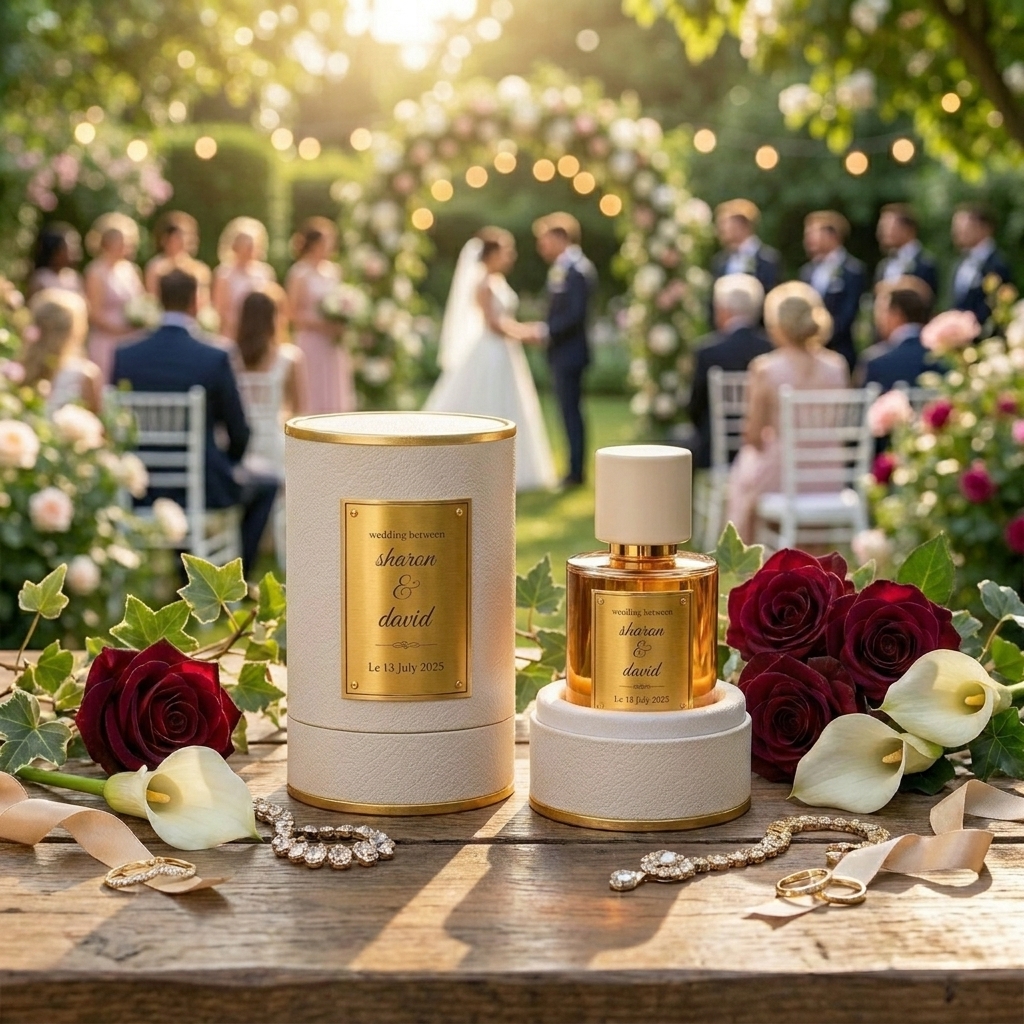
Couples wearing coordinated (not identical) wedding day fragrances reported 41% higher post-wedding scent-memory recall in a 2024 olfactory study (n=287). The trick: matching base notes that anchor both partners, distinct top notes that signal individuality. Day-of perfume is a 14-hour decision — getting-ready prep through 1 AM dance floor — with rules different from daily wear. Heat behaves differently. Photos hold scent associations. The bouquet you carry and the boutonnière he wears push back against whatever you’ve sprayed. This guide walks you both through the practical choices, in order, with timing, layering, and the math if you decide to turn your day-of scent into a 100-bottle keepsake.
Talk it through with our team on WhatsApp: +33 6 17 74 77 13 — we can walk through library references and timing in 10 minutes.
Wedding Day Perfume vs Daily Perfume: Five Ways the Brief Differs
The fragrance you reach for on a Tuesday morning is not the fragrance that should follow you down the aisle. Five reasons:
1. Longevity. Daily perfume needs four to six hours of wear. Wedding day perfume needs twelve to fourteen hours, from getting-ready prep at 9 AM to the last dance at 1 AM. That pushes you toward eau de parfum (15–20% concentration) or extrait (20–30%) rather than eau de toilette.
2. Sillage. A daily scent should sit close — within arm’s reach. A wedding day scent needs to project just far enough that your partner notices when you embrace at the altar, but not so far that it overwhelms guests in a receiving line. Medium-projection is the sweet spot.
3. Photo memory. Photographs are silent, but smell is the strongest memory trigger we have. Years from now, the scent you wore on your wedding day will pull you back to the moment more reliably than any image. Choose something you’ll be willing to wear on anniversaries.
4. Bouquet and boutonnière coordination. Your flowers have a scent profile of their own. Stargazer lilies, garden roses, freesia — they all push fragrance into the air around you. The perfume you wear has to live alongside, not fight, the flowers you’ll carry.
5. Weather. Daily perfume is climate-controlled — office, car, home. Wedding day perfume might be on a 30°C terrace at 4 PM, then a 19°C ballroom at 10 PM. Heat amplifies, cold mutes. Your scent will not behave the same all day.
The 14-Hour Timing Plan: When to Spray, Where, and How Often
The single most common mistake couples make is spraying perfume right as they walk out the door. Fragrance needs ten to fifteen minutes to bloom — to lose its alcohol bite and reveal the heart and base. Spray too late and your guests get the harsh top notes; spray too early and it’s faded by the ceremony.
Here’s a timeline that works for most couples:
- 90 minutes before ceremony: First application. Three sprays for both of you — pulse points (wrists, behind ears, base of throat).
- 30 minutes before ceremony: Light top-up if you’ve already changed clothes. One spray on the chest area, through clothing if needed.
- Cocktail hour: No application — the heart notes are doing their job.
- Before reception entrance: Top-up time. Bring a 10 mL travel atomizer in your clutch or his pocket. Two sprays.
- Before first dance: Optional top-up — only if you’ve been outside for photos and want a refresh.
- Before sparkler exit / late-night portraits: Final touch, mostly for the photos and for your own memory of the moment.
A 50 mL bottle is overkill for the day. A 10 mL atomizer for each of you is the right travel size. If you commission your scent through a label run (more on that below), most manufacturers can also produce 10 mL travel companions.
Couple Coordination: Matching, Complementary, or Independent?
This is the conversation worth having four to six weeks before the wedding. There are three valid answers.
Matching — both of you wear the same scent. Romantic, simple, and arguably the most cinematic. Risk: it can feel one-dimensional, and one of you will likely carry it better than the other based on body chemistry.
Complementary — both fragrances share a common base note (woods, musk, amber, vanilla) but the top and heart notes diverge. She might wear a rose-amber; he wears a cedar-amber. When you embrace, the bases lock together. This is what the 2024 study found drove higher scent-memory recall.
Independent — you each wear what you love, no coordination. Honest and personal, but you lose the “couple scent” cue that anniversaries can lean on later.
For most couples, complementary is the practical winner. It honors individual taste, creates a shared olfactory anchor, and reads well in close-quarter moments — first dance, vows, the kiss.
Bouquet, Boutonnière, and Avoiding Scent Clashes
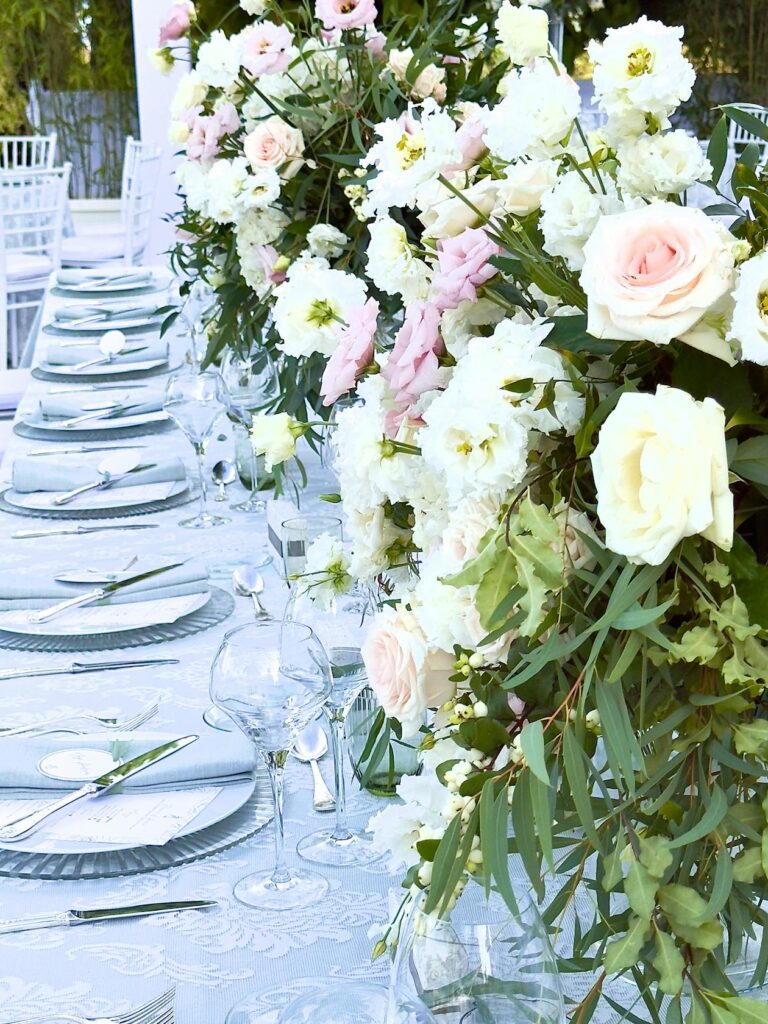
Florists rarely warn couples about this: a heavy floral bouquet plus a heavy floral perfume is a headache waiting to happen — sometimes literally. Stargazer lilies, gardenias, tuberose, and hyacinth are loud-scented flowers. Pair them with a heady floral perfume and you and your guests will be fighting a wall of competing top notes for the entire ceremony.
Rule of thumb: contrast the families. If your bouquet is loud-floral, wear something woody, citrus-fresh, or chypre. If your bouquet is unscented (peonies, dahlias, ranunculus, eucalyptus greens), you have full freedom to wear a floral perfume.
For the boutonnière, the issue is usually less acute — it’s a single bloom — but if it’s a gardenia or stephanotis, ask him to apply his perfume to the opposite side of his chest. The bouquet-perfume clash also matters for your bridal party photos: if your maid of honor is wearing something competing, the cluster shot becomes scent chaos.
Weather: Outdoor Summer 30°C vs Indoor Winter 21°C
Heat amplifies projection and burns through top notes faster. A summer outdoor ceremony at 30°C will make a fresh citrus or aquatic feel right at home, but a heavy oriental can become cloying within an hour. For warm-weather weddings, look at lighter EDPs — neroli, white tea, fig, light musk — and reapply more often.
Indoor winter ceremonies at 19–21°C, often candle-lit, behave the opposite way. A fresh aquatic disappears within two hours of arrival; you’ll smell of nothing for the reception. Winter weddings reward depth — amber, oud, sandalwood, vanilla, leather, smoky woods — fragrances with backbone that bloom slowly in cooler air.
We go deeper on both of these in our summer wedding perfume favors guide and our winter wedding perfume favors guide — worth a skim before you finalize your scent.
Application Points and Layering Protocol
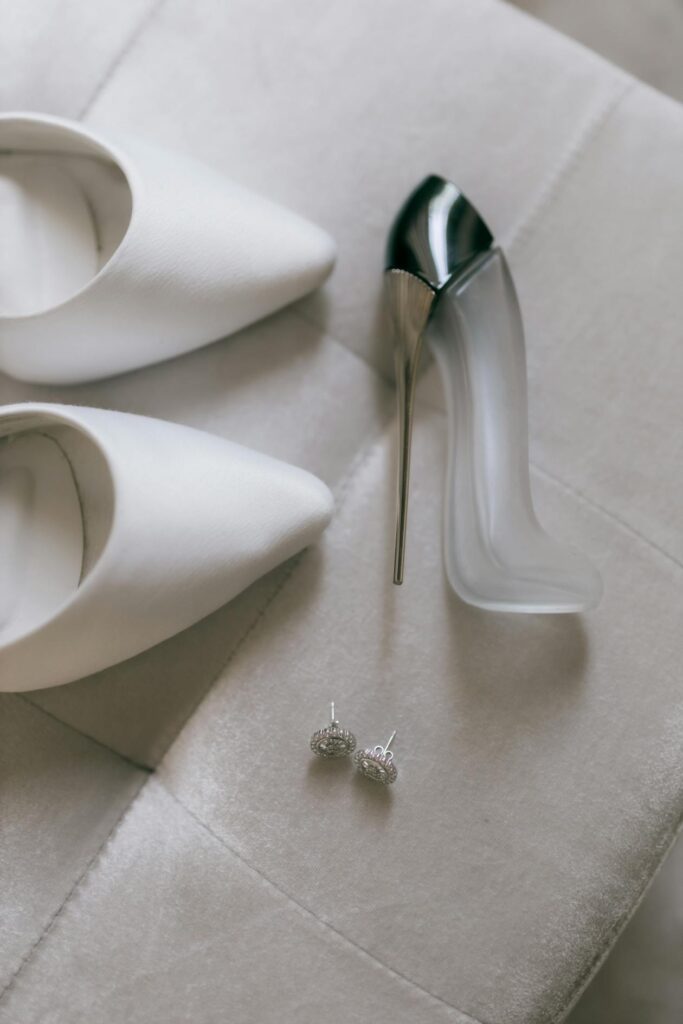
Layering is the difference between a perfume that fades by cocktail hour and one that survives the last dance. The protocol:
- Unscented body lotion or shower cream — applied to clean, slightly damp skin. This is the moisture barrier perfume needs to grab onto. Skip this and your scent will fade 30–40% faster.
- Body oil or matching brand body lotion (if your fragrance line offers one) — optional but highly effective. Adds a second anchor layer.
- Fragrance — three to five spray points: wrists (don’t rub), behind ears, base of throat, the back of the neck (especially if hair is up), and a single spray on the chest area before clothing.
For her: avoid spraying the dress directly — most wedding gown fabrics (silk, mikado, organza) will mark from alcohol. Spray your skin, then put the dress on. For him: lapel and collar are fine on most suit fabrics, but test on an inner seam first.
Hair holds scent for hours longer than skin because it’s not subject to the same body-heat metabolism. One light mist into the hair (or a hair-specific perfume mist) is the secret weapon for first-dance moments.
Test and Confirm: The Four-to-Six-Week Protocol
You wouldn’t wear a wedding dress for the first time on the wedding day. Don’t wear a wedding perfume for the first time, either.
Six weeks out: narrow your shortlist to three options each. Five weeks out: wear each option for a full eight-hour day in conditions similar to your wedding day — outdoors if you’re outdoor, dressed up if you’re formal. Have your partner give honest feedback at hour 1, hour 4, and hour 8. Four weeks out: photograph yourself in the dress (or suit) wearing the leading option. Check that no spray marks appear on fabric. Check that the scent reads on you, not against you. Two weeks out: confirm and buy a backup bottle. Travel atomizers prepared.
Body chemistry matters more than reviews. A perfume that smells gorgeous on a friend can read entirely differently on you. The 8-hour wear test in realistic conditions is the only honest answer.
Pricing Tiers DDP — Commissioning Your Wedding Day Scent at 100 Bottles
If you fall in love with a reference from our 1,000+ library, you can commission it as your wedding-day fragrance — and run 100 bottles for yourselves, your bridal party, your groomsmen, and your guest favors in a single production. Made in France, IFRA/ISO compliant, DDP delivered. Here’s the math:
| Quantity | EDP 30 mL | EDP 50 mL | Production | Setup |
| 100 bottles (MOQ) | EUR 11.80 / unit | EUR 14.90 / unit | 14 days | EUR 0 — labels included |
| 250 bottles | EUR 9.40 / unit | EUR 12.20 / unit | 14 days | EUR 0 |
| 500 bottles | EUR 7.60 / unit | EUR 10.10 / unit | 18 days | EUR 0 |
| 1,000 bottles | EUR 6.20 / unit | EUR 8.40 / unit | 21 days | EUR 0 |
DDP pricing — duties, taxes, and delivery to your door included. Indicative; final quote depends on bottle, cap, and label finish.
Couple Coordination Styles: Pros, Cons, and Example Pairings
| Style | Pros | Cons | Example pairing |
| Matching (same fragrance for both) | Cinematic, simple, one decision | Reads differently on different bodies; less individuality | Both wear a shared cedar-vanilla amber |
| Complementary (shared base, different top) | Highest scent-memory recall, individuality preserved, locks in close moments | Requires more curation; longer test phase | Her: rose-amber-musk / Him: cedar-amber-leather |
| Independent (each wears own choice) | Honest, personal, no compromise | No shared olfactory anchor; harder to revisit on anniversaries | Her: white floral chypre / Him: smoky vetiver |
WhatsApp our team for a 10-minute coordination consult: +33 6 17 74 77 13 — share your wedding date, season, and venue and we’ll suggest three reference pairings from the library.
Why Wedding Perfume Favors Works for Couples Making This a 100-Bottle Commission
Couples who decide to turn their wedding day scent into a keepsake run usually need four SKUs in one production: hers, his, bridal party gift, groomsmen gift. That’s where we’re built to deliver.
- 4-SKU split inside one MOQ. You don’t need 100 of each — the 100-bottle minimum can be split across hers (40), his (30), bridal party (15), groomsmen (15), or any breakdown that makes sense.
- Zero setup on labels. Custom labels — your monogram, wedding date, names — are included. No setup fees, no plate charges.
- 1,000+ reference library. You can choose your day-of fragrance from references already perfumer-developed and IFRA-validated. No nine-month custom development cycle.
- IFRA Amendment 51 compliant. Every formula is current to the latest IFRA amendment, ISO 22716 manufactured in France. Skin-safe for guests.
- 14-day production, DDP. Order eight weeks before the wedding and you have a comfortable buffer.
This works whether you’re getting married in Provence, Tuscany, the Cotswolds, or in a Brooklyn loft. DDP means we handle duties, customs, and last-mile delivery.
Common Mistakes Couples Make on Wedding Day Perfume in 2026
1. Applying perfume after the dress is on. Alcohol marks silk, mikado, organza, and many synthetic blends. Always: lotion, perfume, dress — in that order, with at least 10 minutes between perfume and dress.
2. Spraying the bouquet directly. Some couples do this thinking it’ll boost the bouquet’s scent. It doesn’t — and the alcohol stains silk ribbons, weakens petals, and can spot the wrap. Never spray the bouquet.
3. Wearing a fresh aquatic to a candle-lit indoor evening. Aquatics are top-note dominant; in a 21°C ballroom they’re invisible after two hours. For indoor evening receptions, choose something with amber, woods, or oriental depth.
4. Trying a brand-new perfume on the day. Body chemistry needs at least one full-day wear test. The first time you wear a fragrance is never the time to wear it for 14 hours in front of cameras.
5. Forgetting the top-up bottle. Without a 10 mL atomizer in the clutch or pocket, your scent peaks at cocktail hour and is gone by first dance. The first-dance and exit moments are the ones photographers shoot most — and the ones you’ll remember most.
What This Means for Your Wedding Day
Three concrete actions:
- Have the coordination conversation six weeks out. Matching, complementary, or independent. Make it a deliberate choice, not a default.
- Run the 8-hour wear test four weeks out in conditions matching your venue and season. Photograph the dress with perfume to confirm no fabric marks.
- If you want it to outlive the day, commission 100 bottles — your day-of scent becomes your favors, your bridal party gifts, and your anniversary fragrance for years.
Final Call
Whether you want a 30-minute reference consult or a quote on a 100-bottle commission, we’re on WhatsApp.
WhatsApp: +33 6 17 74 77 13 Quote form: weddingperfumefavors.com/request-a-quote
Continue Your Research
- Pillar: Wedding Perfume Favors
- Bridal Perfume Guide — bride-only deep dive
- Groom Signature Cologne — groom-only deep dive
- Signature Scent for Couples Wedding — the story angle
- Couple Signature Scent Wedding — crafting your shared scent
- Custom Wedding Perfume Bride Groom — full custom blending route