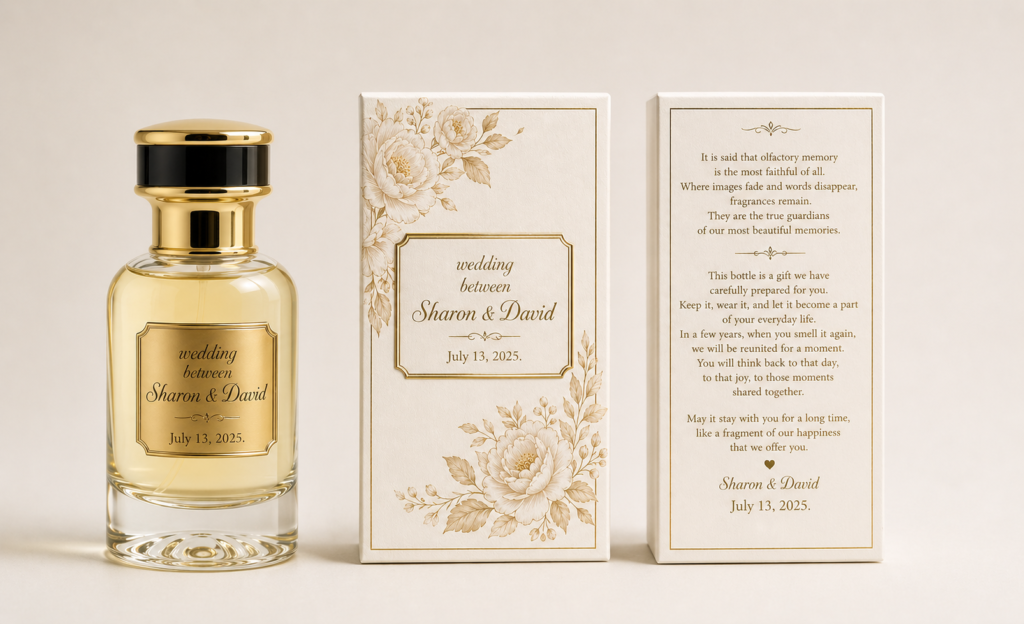
Wedding planning agencies launching a white-label fragrance line build a $35,000-$120,000/year recurring revenue stream with margins of 4-6x cost, compared to reseller margins of 60-80% on a manufacturer-branded SKU. White-label MOQ starts at 200 units per SKU, the development cycle runs 8-12 weeks for a library-match build and 12-16 weeks for a bespoke formula, and Made-in-France IFRA Amendment 51 + ISO 22716 GMP documentation is delivered in the agency’s brand name for international resale. This blog is for agency owners with 10+ event teams and an established brand identity ready to convert their planning equity into a proprietary product line. It is the white-label playbook — not the reseller playbook covered in our companion blog.
Want a white-label scoping call? Send your brand brief and a one-page line concept on WhatsApp +33 6 17 74 77 13 and we’ll return a development workflow, MOQ scenario, and pricing sheet within 48 hours.
Reseller vs white-label — when each model makes sense
Two B2B fragrance models exist for planning agencies, and the economics are not interchangeable.
Reseller model. The agency becomes a preferred-planner for an existing manufacturer brand. The agency buys SKUs at wholesale (typically $4-$8 per unit DDP) and resells at $12-$20 to the end couple. Margin sits at 60-80% on a per-unit basis. The agency carries no brand IP, no formula ownership, no packaging customization beyond a tear-off card. Time to first revenue: 14 days from PO. This is covered in detail in our reseller blog at Wedding Planner Perfume Favors.
White-label model. The agency commissions its own branded fragrance line. The manufacturer produces under the agency’s brand name — packaging, label, insert, certificate of conformity all carry the agency’s logo and trade dress. The agency owns the brand IP. Margin moves from a 60-80% retail uplift to a 4-6x cost multiple, because the agency is selling its own brand at a brand-equity price point ($45-$120 per unit retail) rather than reselling a manufacturer SKU. Time to first revenue: 8-12 weeks for library-match, 12-16 weeks for bespoke formula. MOQ starts at 200 units per SKU.
The trigger for white-label is brand maturity. If your agency runs 80+ weddings/year, has a recognizable visual identity, and clients already ask “do you have anything branded?” — white-label converts that latent demand into a product line. If you’re under 40 weddings/year or still building brand recognition, the reseller model is the right entry.
The white-label development workflow — 6 stages
A white-label fragrance line is not a 4-week project. The development cycle is engineered around regulatory validation and packaging tooling, both of which have non-compressible lead times.
Stage 1 — Brand brief (week 1). Agency submits brand guidelines, color palette, target retail price, fragrance direction (oriental, floral, fresh, woody, gourmand), and target audience. Manufacturer returns a development scope document.
Stage 2 — Packaging design (weeks 2-3). Agency-owned designer or manufacturer’s packaging team produces dielines for box, bottle label, neck collar, and outer carton. Print proofs are validated.
Stage 3 — Fragrance development (weeks 3-7). Two paths: library-match (manufacturer pulls a reference from the 7-year formula archive matching the brief, agency validates) or bespoke (in-house perfumer composes 3-4 mods, agency selects, perfumer refines).
Stage 4 — IFRA validation (weeks 6-8). Selected formula is submitted for IFRA Amendment 51 conformity, allergen panel disclosure, and CPNP notification if EU resale is planned. Compliance pack is generated in the agency’s brand name.
Stage 5 — First batch sample (weeks 8-10). Pre-production sample of 12-24 units is shipped for agency sign-off on fragrance, fill, packaging, and label legibility.
Stage 6 — Production (weeks 10-12). Bulk production runs against approved sample, ISO 22716 GMP batch records are generated, DDP shipment dispatches with the compliance pack.
For bespoke flacon (custom bottle mould), add 4-6 weeks for tooling and validation. For a 3-SKU line built simultaneously, the cycle holds at 12 weeks total because IFRA and packaging validation run in parallel.
Brand-build deliverables — what the agency actually owns
The point of white-label is brand equity. The deliverables reflect that.
- Agency-only branded packaging. No manufacturer logo on the box, the bottle, the label, or the insert. The neck collar, the outer carton, the certificate, and the unboxing card all carry agency branding only.
- Agency-owned brand IP. Trademark, trade dress, packaging artwork, and SKU naming belong to the agency. The manufacturer holds no brand rights — only the manufacturing license to produce against the agency’s brand.
- IFRA + ISO documentation in the agency’s name. The IFRA Amendment 51 conformity statement, the allergen panel, and the ISO 22716 GMP batch records are issued in the agency’s brand name, not the manufacturer’s. This is what allows the agency to resell internationally and answer customs questions as the brand owner.
- Formula license. For bespoke white-label, the agency receives a formula license tied to its brand — meaning the manufacturer cannot produce the same formula for a competing agency. For library-match, the formula remains in the manufacturer’s archive and can theoretically be matched again, which is why bespoke is the long-term defensive position.
Two white-label models: library-match vs bespoke
Library-match white-label. The agency selects a fragrance direction; the manufacturer pulls a matching reference from the 7-year formula archive. The agency adds custom branding (packaging, label, insert) and the SKU launches under the agency’s brand. MOQ 200 per SKU. Lead time 4-6 weeks (faster because the formula already exists and is IFRA-validated). Per-unit DDP $5.80-$8.50. Use this when speed-to-market matters more than fragrance exclusivity.
Bespoke formula white-label. The agency commissions a custom formula. In-house perfumer develops 3-4 modifications based on the brief, the agency selects and refines, the formula is IFRA-validated and licensed to the agency’s brand. MOQ 200 per SKU. Lead time 8-12 weeks (12-16 with custom flacon). Per-unit DDP $9.00-$14.50. Use this when fragrance exclusivity is part of the brand promise and the agency wants long-term defensibility against competitor matching.
Most agencies launch with one bespoke signature SKU plus two library-match supporting SKUs — a hybrid that protects the brand asset where it matters and accelerates time-to-revenue for the supporting line.
Pricing tiers — DDP standard MOQ
| Volume | Per-unit DDP | Lead time | Notes |
| 100-249 units | $7.80-$11.50 | 14-21 days | Stock SKU, manufacturer branding |
| 250-499 units | $6.50-$9.20 | 21-28 days | Stock SKU + tear-off card |
| 500-999 units | $5.40-$7.80 | 28-35 days | Stock SKU + insert customization |
| 1,000-2,499 units | $4.60-$6.50 | 35-45 days | Stock SKU + co-branded sleeve |
| 2,500+ units | $3.90-$5.40 | 45-60 days | Stock SKU + full co-brand |
Pricing tiers — white-label-specific
| White-label model | MOQ per SKU | Per-unit DDP | Lead time | Brand IP ownership |
| Library-match white-label | 200 units | $5.80-$8.50 | 4-6 weeks | Agency owns brand assets |
| Bespoke formula white-label | 200 units | $9.00-$14.50 | 8-12 weeks | Agency owns brand + formula license |
| Bespoke + custom flacon | 300 units | $14.50-$22.00 | 12-16 weeks | Full IP ownership |
| Strategic line (3+ SKUs) | 600 units total | $5.50-$11.00 | 8-14 weeks | Full IP + co-development |
The strategic line tier is where most established agencies land at 18-month maturity: 3 SKUs, 200 units each, 600 units total committed, blended per-unit DDP $5.50-$11.00 depending on bespoke ratio. It produces a balanced line at a working capital level most 10+ team agencies can absorb.
Send your line concept on WhatsApp +33 6 17 74 77 13 and we’ll model two MOQ scenarios — single-SKU bespoke launch vs 3-SKU strategic line — with full per-unit DDP and working capital schedule.
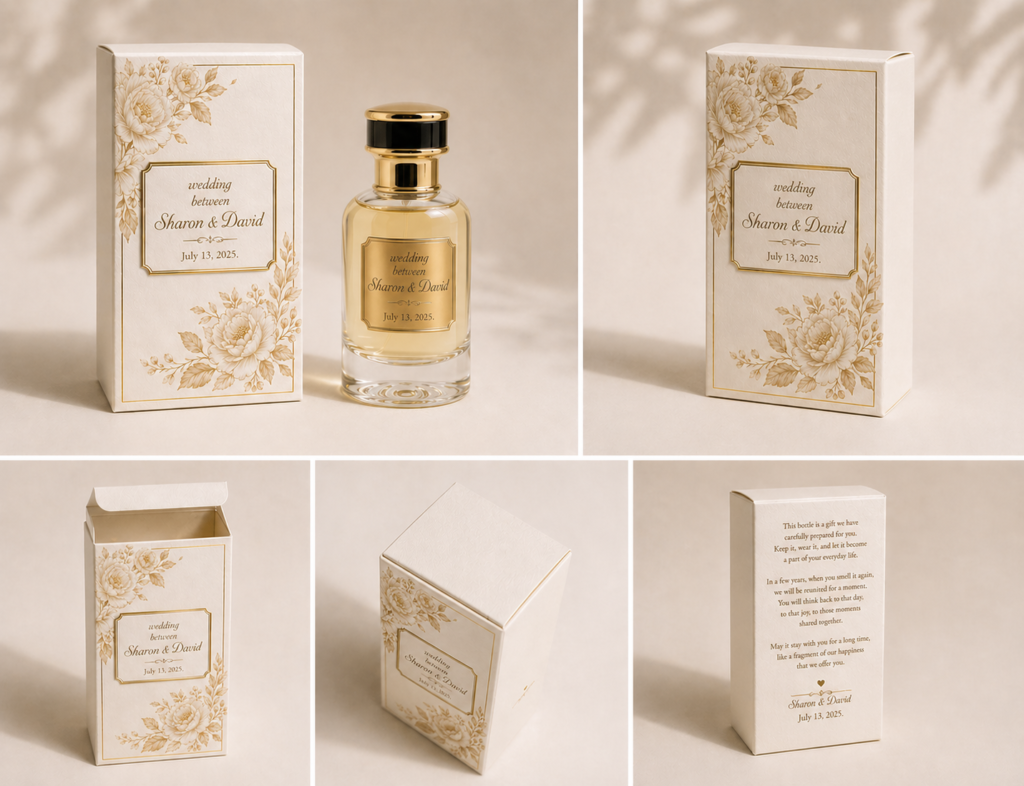
IFRA + ISO compliance pack — agency receives full documentation
Compliance is what separates a white-label line that can be sold internationally from a private-label gift item that cannot leave the home market. Every batch ships with a compliance pack issued in the agency’s brand name:
- IFRA Amendment 51 conformity statement. Confirms the formula complies with the current International Fragrance Association standard, signed by the manufacturer’s regulatory officer in the agency’s brand name.
- Allergen panel. Full disclosure of the 26 EU-listed allergens present above the labeling threshold, formatted for label printing and e-commerce listing.
- ISO 22716 GMP batch records. Manufacturing records confirming the batch was produced under cosmetic Good Manufacturing Practice — required for retail in the EU, UK, GCC, Canada, and increasingly the US for high-volume e-commerce.
- Safety Data Sheet (SDS) and transport classification. Required for cross-border DDP shipping, hotel B2B sales, and any retail channel that audits supplier compliance.
- CPNP notification (on request). For EU resale, the formula is registered on the European Commission’s portal under the agency’s responsible person.
This is the documentation the agency uses to onboard with hotel groups, department stores, premium e-commerce platforms, and international destination-wedding venues. It is what makes the white-label line a defensible brand asset rather than a private souvenir.
Cross-site reference — full private-label process
For agencies scaling beyond a single white-label fragrance into a multi-SKU branded line (eau de parfum, candle, room spray, body care under a unified brand), the full private-label process documentation lives on our sister site at https://www.world-perfume.com/private-label-perfume/. That documentation covers extended product categories, multi-format launches, and the regulatory framework for non-fragrance cosmetic categories. For wedding-specific white-label fragrance, this blog and the workflow above are the operational playbook.
Building your fragrance line — 3-4 SKUs to start, 6-8 at maturity
A wedding-planning fragrance line is not a single SKU. It is a wardrobe.
Launch line (months 0-6) — 3-4 SKUs. 1. Signature. The bespoke formula that anchors the brand. White floral, oriental, or chypre depending on agency positioning. This is the SKU that defines the line. 2. Cocktail. A higher-projection evening fragrance for the reception. Gourmand, oriental, or amber. 3. Light day. A fresh, low-projection daywear fragrance for the morning of the wedding and the bridal-prep window. Citrus, green floral, or aquatic. 4. (Optional) Groom. A masculine companion SKU. Woody, fougere, or aromatic.
Maturity line (months 18-24) — 6-8 SKUs. Add a unisex floral, a deeper evening oriental, a destination-wedding fresh, and a bridal-party gift size.
The volume math: at 80 weddings/year and 60% line attachment, an agency moves 250-400 units annually across the line. At 4-6x cost margin and a $60-$95 retail price point, that produces $35,000-$120,000/year in gross fragrance revenue — recurring, brand-locked, and not dependent on planning fee structure.
Why Wedding Perfume Favors handles white-label development for planning agencies
- Made-in-France manufacturing under IFRA Amendment 51 + ISO 22716 GMP. Documentation is issued in your agency’s brand name for international resale.
- In-house perfumer team. Bespoke formula development handled by senior perfumers, not outsourced. 3-4 mods per brief, refinement included in the development fee.
- Full packaging customization. Boxes, bottles, labels, neck collars, inserts, outer cartons, certificates — all customizable, all dielined to your brand guidelines.
- 7-year formula archive. Library-match white-label draws from a curated archive of validated formulas, which compresses the development cycle from 12 weeks to 4-6.
- DDP shipping. Duties, taxes, and import handling are prepaid. The line lands at your warehouse or 3PL ready to ship to your end clients.
- Brand IP protection. The agency owns trademark, trade dress, and packaging artwork. For bespoke, the formula license is exclusive to the agency’s brand.
Common mistakes planning agencies make on white-label fragrance launches in 2026
- Starting with 6 SKUs = 1,200 unit MOQ commitment. Working capital exposure is too high at launch. Start with 3 SKUs (600 units), validate sell-through over 6 months, then scale.
- Treating white-label as a 4-week project. Library-match is 4-6 weeks at the earliest, bespoke is 8-12, custom flacon is 12-16. Build the launch calendar around the development cycle, not the other way around.
- Skipping the bespoke signature. Library-match across the entire line means the formula is theoretically replicable for a competitor. The signature SKU should always be bespoke with formula license.
- Underpricing the line at retail. White-label is not reseller. The retail price reflects brand equity, not unit cost-plus. Agencies pricing at $25-$35 leave 60% of margin on the table — the line should retail at $60-$120 depending on positioning.
- Ordering compliance documentation in the manufacturer’s name. IFRA, ISO, and CPNP must be issued in the agency’s brand name from day one. Re-issuing later is possible but slow and adds cost.
What this means for your agency brand strategy
- Audit your current event volume and brand recognition. If you run 80+ weddings/year with established visual identity, white-label is a brand-asset move, not a side project. Commit MOQ accordingly.
- Decide on bespoke vs library-match for your signature SKU before scoping packaging. This decision drives the development timeline and the long-term defensibility of the line.
- Build the 18-month roadmap before placing the first PO. Launch line of 3 SKUs, validation window, maturity line of 6-8. Working capital, warehousing, and 3PL onboarding are scoped against the roadmap, not the launch SKU.
Ready to scope your white-label fragrance line?
Send your brand brief, target retail price, and one-page line concept on WhatsApp +33 6 17 74 77 13 or via the quote form at https://www.weddingperfumefavors.com/request-a-quote. We’ll return a development workflow, two MOQ scenarios (single-SKU bespoke vs 3-SKU strategic line), full DDP pricing, and a working capital schedule within 48 hours. The white-label development call is 45 minutes — bring your brand guidelines and your retail positioning, we’ll bring the manufacturing, regulatory, and packaging architecture.
Continue your research
- Pillar overview: Wedding Perfume Favors (Pillar)
- Reseller alternative (manufacturer-branded SKUs): Wedding Planner Perfume Favors
- Wholesale Net 30 program: Wholesale Wedding Perfume Favors
- Event companies B2B framework: Event Companies Perfume Favors
- Bulk specifications and tooling: Bulk Wedding Perfume Favors
- Editorial benchmarks: Best Wedding Perfume Favors
- Cross-site full private-label process: https://www.world-perfume.com/private-label-perfume/